
Top 7 Skid Steer Fork Attachments Compared: Features and Prices
Investing in the right skid steer fork attachments can be a game-changer for your compact loader by turning it into a high-powered forklift on a small scale that can deal with everything from building rubbish to delicate palletized goods.
It is critical to pick the most suitable forks if you are running a warehouse, worksite, or farm and need to maximize your machine’s efficiency and profitability. Given the large number of different products you can find online now, comparing features such as frame strength, fork length, and weight capacity becomes vital so that you neither overpay for features that you won’t use nor buy a product that can’t handle the job.
Picking up the best skid steer fork attachments is not only about the money; a considerable part of the task is to check the carriage engineering and the quality of the metal used. Walk-through” frame designs for better cab access, high-visibility backplates, and hydraulic adjustment features for switching between different load widths quickly are some of the advanced features of the attachments today.
This detailed review compares the seven leading brands in the market and gives you the technical specifications and price information to help you decide.
Top 7 Skid Steer Fork Attachments:
1. Standard Series Pallet Fork Frame Attachment
The Standard Series has been the most widely used brand for years and targets the consumers who mostly want functioning without any fancy features of the professional-grade units. Almost each model in this product line features a universal skid steer quick-tach mount, thus allowing the user to work with the most popular brands such as Bobcat, CAT, or John Deere. It is an ideal choice for general material handling and features a good balance between weight and toughness.
- Load capacity: Standard models generally have the capacity rated at 4,000 lbs, so they are perfect for the transport of feed, timber, and normal pallets.
- Visibility features: Equipped with a “see-through” headache rack allowing the operator clear a view the fork tips so that he/she can load precisely.
- Adjustable tines: Comes with a notched rail system by which the operator is able to slide the forks to different widths to fit a pallet of any size manually.
2. Heavy-Duty “Walk-Through” Pallet Forks
Walk-through fork frames have gained popularity due to the safety and convenience they provide to the users. Through the center opening of the backframe, the operator can walk through the attachment to enter or exit the skid steer cab with ease. It is useful for a situation when the operator has to get out of the machine frequently for load adjustments or cleaning of the area.
- Improved safety: An open-frame layout basically means that there is no need to climb over the attachment thus the risk of falling down is significantly less.
- Higher capacity: Grade 50 steel with a thorough reinforcing is the common material of these forks and you may always find them rated at 5,500 lbs or even more.
- Step plates: Non-slip side steps built-in give you extra safety points of contact when entering and leaving in the mud.
3. Hydraulic Sliding Pallet Fork Attachment
Hydraulic sliding pallet forks are a revolution in the market of high-productivity warehouse equipment where it is one of the most important tasks to handle different load widths. The operator doesn’t have to get out of the cab and lift manually then slide heavy steel tines any longer since adjusting the fork spacing can be done right from the cab using the machine’s auxiliary hydraulics. Hence, it is regarded as an elite choice for logistics hubs and large industrial complexes.
- Cab-operated convenience: The forklift width can be adjusted anytime to suit your needs and save time, plus the operator’s physical effort is also minimized drastically.
- Handling precision: This is a perfect tool to carry out the picking of very specialized equipment or non-standard pallets that require accuracy down to the last millimeter.
- Heavy-duty: Due to the fact the hydraulic cylinders and reinforced carriage have to be capable enough to support the mechanism, the price is generally higher.
4. Economy Series Lightweight Forks
There are jobs which do not require a lifting capacity of 6,000 lbs at all. To target the small sub-compact tractors and lower end skid steers where the weight of the attachment is a critical factor, an Economy Series fork has been developed. By implementing a lightweight frame, the forks can deliver more rated operating capacity (ROC) of the machine for the actual load being carried.
- Weight optimized: A lighter frame makes it possible for smaller machines to lift even more material before coming to a tipping point.
- Cheap and cheerful: It is the usual lowest price level for bidders, new or hobby farmers.
- Compact design: Shorter fork lengths (36″ to 42″) are normal which means they are easier to handle in narrow barn aisles or small backyards.
5. Pro Series Extra Wide Pallet Forks
If you want to manually handle heavier items like large round bales, wide crates, or long PVC pipes, a 45-inch frame is not enough. Pro Series Extra Wide tines have widths up to 60 or 72 inches, which allow for lateral stability and thus prevents long loads from tipping or wobbling during transport.
- Maximum stability: The wider footprint distributes weight across a larger area, protecting the machine’s lift arms from torsional stress.
- High load rating: Usually rated for 6,000 lbs to 10,000 lbs, catering to the most demanding industrial applications.
- Multi-tine compatibility: Some models allow for the addition of third or fourth tines to support flexible materials that might sag in the middle.
6. Skid Steer Fork Grapple Attachment
When combined with a hydraulic grapple arm, a fork grapple becomes the hybrid attachment capable of lifting, securing, and carrying loose bulk materials such as logs, scrap metal, wreckage, or debris. The main benefit, apart from the primary functionality of the pallet forks, is that the operator will no longer have to worry about load stability and, therefore, about safety losses from loose material falling off the load during transport.
- Dual functionality: On one hand, it serves as a normal pallet fork for flat loads and, on the other hand, it is a grapple for bulky, round, or irregular ware.
- Secure transport: The hydraulic top arm clamps down on the load, ensuring that nothing falls off even if the ground is uneven.
- Independent tines: Usually, you will find an adjustable lower tines configuration which allows the base width to be set before the grapple is engaged.
7. Class 3 High-Capacity Industrial Forks
Class 3 forks are an exclusive solution for super-large “big-frame” skid steers and telehandlers. Steels used for manufacturing standard commercial units are much less thick compared to these. Besides that, the carriage is taller to be able to accommodate higher weights. These forks are frequently seen in use at masonry yards (brick and stones cubes) and in heavy construction (concrete forms) etc.
- Ultimate strength: The tines are made from forged steel that is 1.25″ to 1.5″ thick to eliminate any possibility of bending under maximum pressure.
- Huge capacity: Models can vary from 7,500 lbs to 12,000 lbs peak load, which has a direct relation with the variant chosen.
- Secure locking mechanism: Heavy-duty locking pins ensure the forks remain perfectly stationary even when subjected to high-impact side loading.
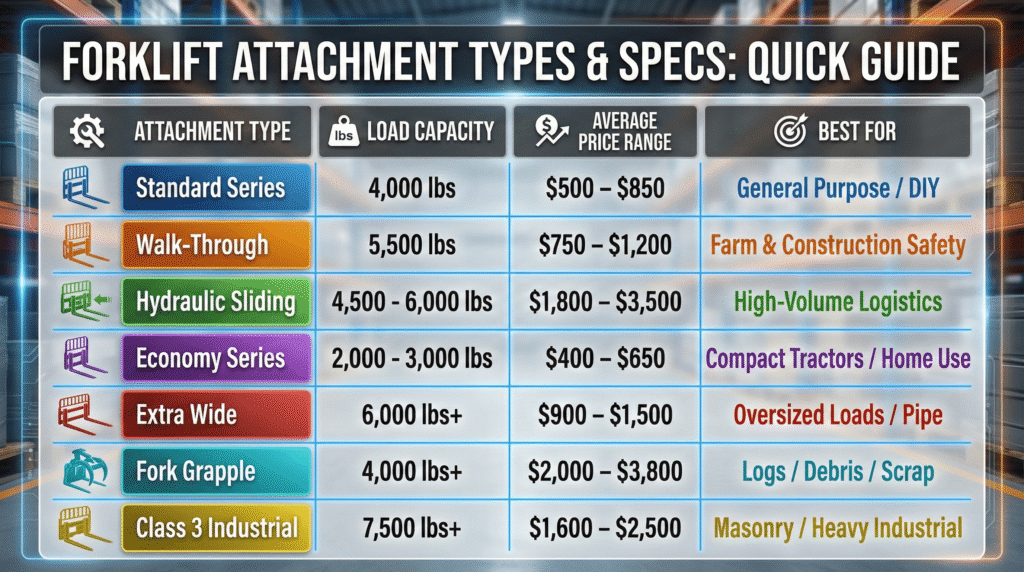
Feature & Price Comparison Table: Top 7 Skid Steer Fork Attachments
| Attachment Type | Load Capacity | Average Price Range | Best For |
| Standard Series | 4,000 lbs | $500 – $850 | General Purpose / DIY |
| Walk-Through | 5,500 lbs | $750 – $1,200 | Farm & Construction Safety |
| Hydraulic Sliding | 4,500 – 6,000 lbs | $1,800 – $3,500 | High-Volume Logistics |
| Economy Series | 2,000 – 3,000 lbs | $400 – $650 | Compact Tractors / Home Use |
| Extra Wide | 6,000 lbs+ | $900 – $1,500 | Oversized Loads / Pipe |
| Fork Grapple | 4,000 lbs+ | $2,000 – $3,800 | Logs / Debris / Scrap |
| Class 3 Industrial | 7,500 lbs+ | $1,600 – $2,500 | Masonry / Heavy Industrial |
FAQs – Top 7 Skid Steer Fork Attachments
Will these pallet forks fit my specific skid steer brand?
Yes, most modern skid steer fork attachments use a Universal Quick Attach (SSQA) system. This industry standard ensures that as long as your loader has the two-lever locking system, forks from brands like Titan, Loflin, or Blue Diamond will fit Bobcat, Case, CAT, Kubota, and John Deere machines. Always confirm with your dealer before making a purchase if your machine uses a proprietary hook-and-pin system.
What is the difference between 42-inch and 48-inch forks?
A 48-inch fork is considered a standard measure for handling full-size shipping pallets (which have a depth of 48″). 42-inch forks are typically chosen when space is at a premium or when lifting heavy objects because the center of gravity remains closer to the machine. The lesser the fork length, the lesser the load’s leverage against your loader, which very often leads to having a more stable lift.
Can I use skid steer forks on a tractor front-end loader?
Absolutely, provided your tractor loader is equipped with a skid steer style quick-tach mounting plate. Many compact and utility tractors now come standard with this plate. On the other hand, you need to consider the lift capacity of your tractor; a heavy set of forks might eat up too much of your loader’s power, thus making the remainder too small for the payload.
Are “walk-through” frames worth the extra money?
For the majority of the professionals, the answer is definitely yes. In addition to the obvious safety improvements which refer to getting in and out of the cab by stepping through the middle of the frame vs. climbing over tilt cylinders and forks that may be greasy and slippery, this feature also lessens the wear and tear of the operator’s muscles from the repeated motion.
How do I maintain my fork attachments?
Maintenance is quite straightforward but also essential. Always keep an eye on fork tines and look for any crack or bend. The sliding rails should be clean and lubricated to some extent so that the forks can easily be adjusted. If your fork is a hydraulic one, it pays to regularly check the hoses for signs of wear due to rubbing and keep the quick-couplers free from dirt before attaching them to your machine.
Should I buy forged forks or fabricated forks?
Forged steel tines should always be the first choice if only they are available. Forging is a process of heating and hammering the steel into a desired shape that results in a grain structure that is much stronger inside compared with the case when pieces of steel are simply welded together. The majority of reputable skid steer fork attachments manufacturers use forged tines for their products.