
Fleet Solutions for Contractors: Commercial Grade Mini Loaders
Efficiency, accuracy, and flexibility are becoming more important in modern construction and landscaping. For a long time, big machines were the most common tools on the job site. But now, more and more contractors are using commercial grade mini loaders to fill the gap between manual labor and heavy-duty work.
These small but powerful machines, especially the TYPHON STOMP series available at SteerSkid.com, are the most important part of fleet solutions for contractors who need to work in tight residential areas, busy construction sites, and complex landscaping projects without losing the hydraulic power they need for tough jobs.
Fleet Solutions for Contractors: Commercial Grade Mini Loaders
A commercial grade mini loader isn’t just a smaller version of a skid steer; it’s a tool made for professional use at high frequencies. For a contractor, adding these machines to their fleet means lowering the costs of moving large equipment while also raising the number of services they can charge for.
The mini loader is very useful for a lot of different tasks, like digging trenches for utility lines, cleaning up trash in a park, or laying the groundwork for a house in the backyard. It makes sure that no part of a project is left to slow, manual methods.
A “multi-tool” approach to business growth is possible when you buy a fleet of mini loaders. A single machine can go from being a digging tool to a material handler in just a few minutes with the right attachments, which can include 4-in-1 buckets, trenchers, and augers.
A commercial grade solution is one that can keep working at its best and stay up for a long time, even when it’s used to its fullest extent every day.
The Evolution of Compact Performance on the Job Site
The commercial grade mini loader is becoming more popular because of the “smaller is better” trend in city building. Contractors can’t afford to bring in machines that need wide turning radiuses or heavy trailers because lots are getting smaller and project timelines are getting shorter.
The goal of these machines’ development has been to improve the “power-to-weight” ratio so that even a machine that weighs less than 2,000 pounds can break through tough clay or lift heavy things.
- Flexibility in Small Spaces: Mini loaders can fit through standard garden gates and narrow alleyways, which is something that traditional skid steers can’t do.
- Less Damage to the Ground: Commercial mini loaders are perfect for finished landscapes because they have a smaller footprint. This lowers the cost of restoring the site after the job is done.
- Lower Operating Costs: These machines use less fuel and need less maintenance than their full-sized counterparts, which directly affects a contractor’s bottom line.
Inside the TYPHON STOMP Series: Engineering Excellence
The TYPHON STOMP series is a great example of durable engineering made just for the US market when it comes to commercial grade mini loaders. These machines are made with the knowledge that a contractor’s tools are their means of making a living.
The STOMP series, which comes in both gas and diesel versions like the Kubota D1105, has high-torque engines and reinforced hydraulic systems that make sure it works well in any setting.
- High-Torque Output: Engines like the 23HP B&S or the Kubota Diesel give you the torque (up to 50NM) you need to easily use attachments like augers and rock breakers.
- Strong hydraulic systems: The 4-wheel drive hydraulic systems make sure that movement is smooth and control is exact, which is important when working near buildings or utilities that need to be protected.
- Easy to Maintain: These machines are made for professionals and have service points that are easy to reach, so you can do quick daily checks and keep downtime to a minimum during busy times.
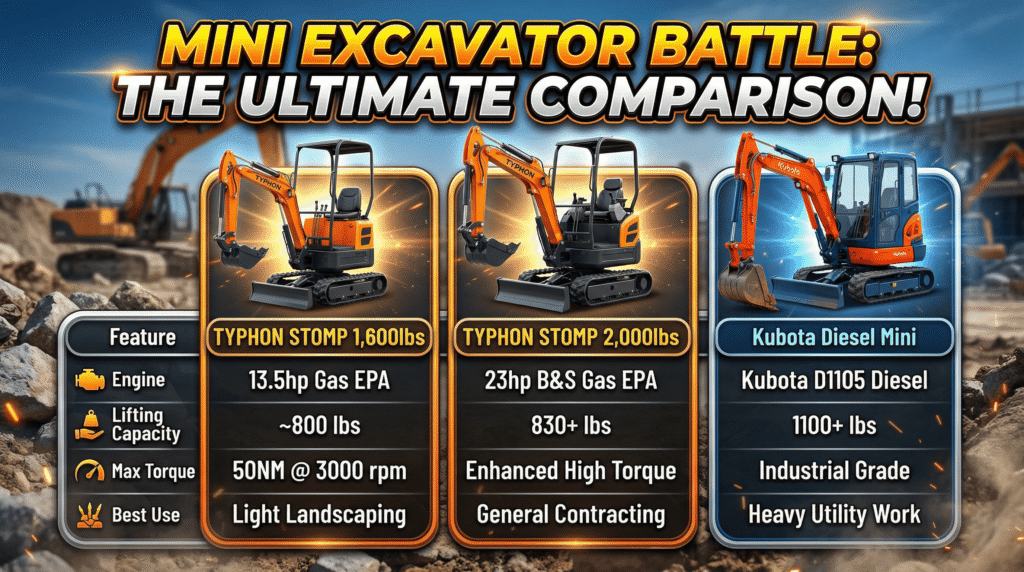
Table: Typhon Skid Steer Features
| Feature | TYPHON STOMP 1,600lbs | TYPHON STOMP 2,000lbs | Kubota Diesel Mini |
| Engine | 13.5hp Gas EPA | 23hp B&S Gas EPA | Kubota D1105 Diesel |
| Lifting Capacity | ~800 lbs | 830+ lbs | 1100+ lbs |
| Max Torque | 50NM @ 3000 rpm | Enhanced High Torque | Industrial Grade |
| Best Use | Light Landscaping | General Contracting | Heavy Utility Work |
Multi-Use Attachments: Making one machine into a fleet
The best thing about a commercial grade mini loader is that it can change. For contractors, having a mini loader is like having ten different tools. SteerSkid.com models have quick-attach mounting systems that let operators switch between tools in a matter of seconds. This flexibility is what makes these machines the best choice for a fleet. A small team can use them for excavation, demolition, and cleaning up a site without needing a lot of different vehicles.
- 4-in-1 Buckets: This attachment is a must-have for any contractor because it lets you dig, load, level, and pick up trash all with one tool.
- Augers and Trenchers: Augers and trenchers are important tools for utility workers and fencing contractors. They make clean, accurate holes and trenches even in rocky soil.
- Grapples and Sweepers: These attachments are great for cleaning up after the fall and tearing down buildings. They make it easy to move things like logs, brush, or concrete rubble that aren’t straight.
Getting the most out of your investment for contracting companies
Return on investment (ROI) is the most important number for any contractor who is thinking about adding to their fleet. Mini loaders for commercial use are one of the fastest ways to make money with equipment. The costs of moving them around are much lower because they can be put on regular trailers or even in the back of some big trucks. Also, being able to do jobs that competitors with bigger equipment can’t bid on, like indoor demolition or backyard renovations, opens up a small, high-margin market.
- Less Work: One mini loader can often do the work of three or four workers, which means that a contractor can do more jobs each month with a smaller crew.
- Service Expansion: A general contractor can offer specialized services “in-house” instead of hiring them out by adding attachments like a rock breaker or a trencher.
- High Resale Value: Because they last a long time and are always in demand in the construction market, commercial grade loaders keep their value well over time.
Why Fleet Solutions Needs Reliable Support
The support behind a machine makes it work better. For contractors, a breakdown on the job can mean lost money and a bad reputation. SteerSkid.com stresses that it is a partner, not just a vendor, for this reason. Contractors can be sure that parts and help are always available because there is a warehouse in the US and technical support is available 24/7. Reliability is the secret to every fleet solution that works.
- Fast 14-Day Delivery: Getting equipment to the job site quickly is important for meeting project deadlines, and SteerSkid makes sure that shipping from US warehouses is quick.
- Expert Help: If you have a question about hydraulics or engine maintenance, being able to get help 24 hours a day, seven days a week means less “trial and error” and more “up and running.”
- Quality Guarantee: SteerSkid helps contractors build infrastructure that lasts for generations by giving them the best products on the market.
How to Make Your Business Future-Proof with Compact Technology
The move toward smaller, more efficient machines will only speed up as labor costs go up and environmental rules get stricter. The commercial grade mini loader is the future of the business. Contractors who use these fleet solutions today are not only fixing their current logistical problems, but they are also protecting their businesses from a market that values accuracy and efficiency over size.
- Complying with the EPA: The TYPHON series’ modern engines meet strict emission standards, which means they can be used on government and municipal projects.
- Integration of technology: These machines are made for today’s workers who want comfort and ease of use, with features like advanced hydraulic controls and ergonomic operator stations.
- Scalability: A business can grow its operations naturally based on demand by starting with one mini loader and adding more specialized units as needed.
FAQs – Fleet Solutions for Contractors: Commercial Grade Mini Loaders
What is the difference between a mini loader for home use and one for business use?
A mini loader made for commercial use is meant to be used every day and at a high level of intensity. It has reinforced steel parts, high-flow hydraulic systems, and industrial engines (like Kubota or B&S) that are made to run for long periods of time without getting too hot or losing power.
Can a mini loader lift heavy things on a construction site?
Yes, models like the TYPHON STOMP are made to lift between 800 and 1,100 pounds, depending on the model. They are smaller than full-size skid steers, but they are balanced in a way that maximizes their lifting capacity while keeping their footprint small.
What kinds of attachments do general contractors find most useful?
The 4-in-1 bucket, the trencher, and the auger are the most common “starter” attachments for a contractor’s fleet. The 4-in-1 bucket is useful for a lot of different jobs, the trencher is useful for utility work, and the auger is useful for digging post holes. These three tools can do about 80% of the tasks that are common on sites.
How do mini loaders work on lawns and other delicate surfaces?
Mini loaders have a much lower PSI (pounds per square inch) on the ground than traditional machinery because they are much lighter and often use wide tracks or special tires. This stops ruts and damage to the grass, which is why landscapers like them best.
Do you need special training to drive a mini loader?
Mini loaders have controls that are easy to use and understand, but it’s always a good idea to get safety training. Most operators can learn how to use the basic controls in a few hours, but it’s important to know the limits of the load and how stable the terrain is for safe operation.
How easy is it to move a mini loader from one job site to another?
This is one of the best things about them. Most commercial grade mini loaders can be towed behind a regular pickup truck on a standard utility trailer. This means you don’t need a CDL (Commercial Driver’s License) or heavy-duty transport vehicles.
How do you take care of a mini loader?
Checking the levels of hydraulic fluid, engine oil, and air filters on a regular basis is part of normal maintenance. Cleaning the radiators and greasing the pivot points every day is important for making sure that these machines last a long time because they work in dusty places.