
Choosing Durable Grapple Attachments for Skid Steers: Steel Thickness Guide
When your skid steer is being used for landscaping, demolition, or agricultural work that requires heavy-duty, the performance of your machine depends on the attachment you use. Skid steer grapples are amongst the most multifunctional tools in a fleet, owing to their capacity to grab, lift and transfer uneven loads like logs, brush, and concrete debris. But different grapples differ in qualities. The inevitability of your gear wears extremely on the quality and thickness of the steel of which it is made.
When trying to choose durable grapple attachments for skid steers, one has to learn to recognize the technical specifications. It is the steel thickness- the frame strength- that determines whether your attachment will survive for a decade or crack under the first heavy load, not the painting or design. At SteerSkid, our primary focus is efficient engineering that can take the machinery and attachments through the toughest and roughest job sites.
Features:
- A structural integrity component: The use of heavy gauge steel for the tines ensures that they will not bend when rocks or heavy roots are being pried out.
- Weight Distribution: Appropriate steel thickness gives the required counterweight for excellent balance during high-lift operations.
- Wear Resistance: More “sacrificial” material is provided when thicker plates are used, which can last for years despite constant abrasive contact with gravel and debris.
Understanding Steel Grades and Tine Strength
Choosing steel grade is the first and foremost decision in making a durable grapple. The majority of quality attachments are made of high tensile strength steel, which makes it possible for these units to be relatively light in weight without compromising resistance to plastic deformation.
In the steel thickness guide, you will find the thickness of 3/8″ to 1/2″ as the normal range for standard duty, and the thickness will increase up to 3/4″ and even 1″ for the heavy-duty industrial grapples.
In the case of using TYPHON STOMP mini skid steers or bigger ones, it would be of great importance to match the steel weight of the grapple attachment to the machine’s lift capacity. The consequence would be that the attachment will twist if the steel is too thin.
You can’t get the net lifting capacity if the steel is unnecessarily thick. The GRAPPLE SYSTEM is well made with gussets that are reinforced and side plates that are quite thick in order to be able to distribute the stress (force) evenly over the frame.
- High-Tensile Steel: Materials such as AR400 or A36 are good grades to consider, as they are easy to weld yet also offer high hardness.
- Reinforced Tines: Try to confirm the reinforcement of the tines since the tips take the greatest pressure.
- Gusset Support: A load-bearing gusset application of at least three internal gussets per tine is recommended for heavy-duty land clearing.
The Role of Steel Thickness in Daily Operations
Among others, in earthmoving and site preparation world, the term “durable” is sometimes used as if it was a slogan only but in fact, it’s really a safety measure and as such needs to be taken seriously.
The thicker the steel, the more effective is the hydraulic cylinder clamping force. If the top lid of a grapple attachment is made from thin steel, the hydraulic cylinders may cause the frame to warp or ‘oil-can’ over time, resulting in the tines becoming misaligned and gripping performance deteriorating.
By strictly following a steel thickness guideline, operators will be able to easily tell the difference between “brush only” attachments and “demolition” ones. Typically, a 1/2″ tine thickness in a grapple for general farm and construction works is considered a standard across the industry. Lower thickness could be used for light landscaping but certainly will not be able to take on commercial work.
- Clamping Power: Use of thick-walled steel tubing in the lid of a grapple attachment helps avoid it getting twisted during the hydraulic pressure maximum.
- Pivot Point Durability: Pivot pins made of thicker steel are kept tight and do not “egg out” even after a lot of usage.
- Cylinder Protection: Robust grapples are often equipped with steel guards to protect the cylinders and hoses from possible impacts of/logs and rocks falling down.
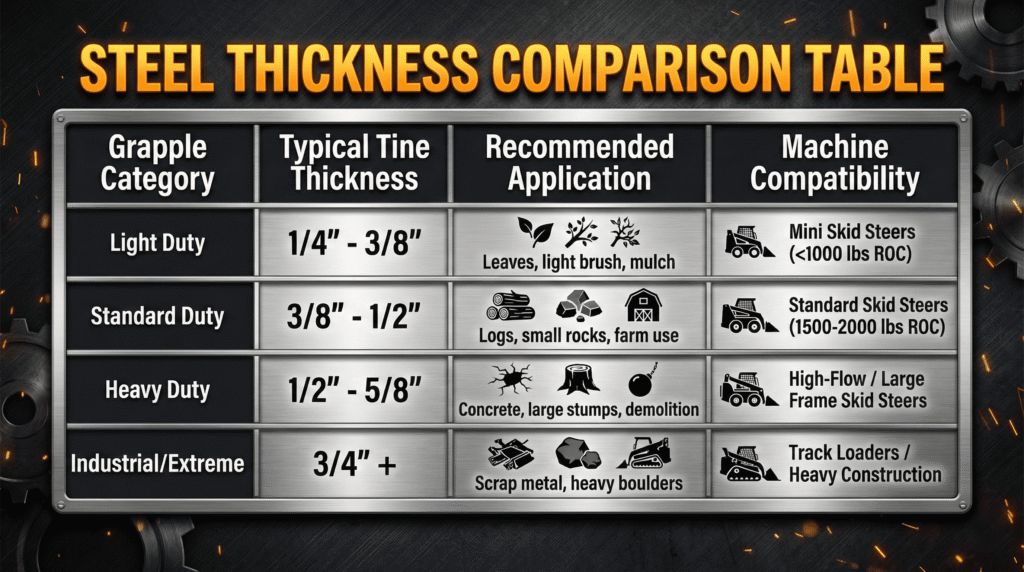
Steel Thickness Comparison Table
| Grapple Category | Typical Tine Thickness | Recommended Application | Machine Compatibility |
| Light Duty | 1/4″ – 3/8″ | Leaves, light brush, mulch | Mini Skid Steers (<1000 lbs ROC) |
| Standard Duty | 3/8″ – 1/2″ | Logs, small rocks, farm use | Standard Skid Steers (1500-2000 lbs ROC) |
| Heavy Duty | 1/2″ – 5/8″ | Concrete, large stumps, demolition | High-Flow / Large Frame Skid Steers |
| Industrial/Extreme | 3/4″ + | Scrap metal, heavy boulders | Track Loaders / Heavy Construction |
Why Typhon Machinery Standards Matter
Through our Typhon Machinery journey, SteerSkid has become deeply aware of the fact that durability is a crucial quality of any attachment. On this occasion, whether it be the 4-in-1 bucket, or a root grapple only, the point of emphasis is the set of words given by the acronym STOMP: Strength, Toughness, Operating-ease, Maintenance-simplicity, and Power. Our product range is capable of handling a torque of 50NM and a high-pressure hydraulic system as found in modern compact loaders.
Choosing durable grapple attachments for skid steers entails much more than just the price factor. Imports at cheap prices usually come with “soft” steel, which does not have the right carbon content to give the metal its memory.
Our guides are emphasizing that investing a little more at the start in thicker, high-grade steel, is going to pay you back over and over again via the elimination of downtimes and cutting of repair costs.
- Premium Engineering: With a laser-cutting technology, every plate can be perfectly aligned and structurally synergized.
- Corrosion Resistance: A premium steel along with an industrial powder coat will prevent rust from degrading the structure.
- Universal Fitment: Reinforced with heavy steel plates for a secure connection, our grapples utilize the standard universal quick-attach system.
Maintenance Tips for Long-Lasting Steel Attachments
The inherent thickness of the steel is a factor that determines the strength of the steel but even this factor can be reduced if the steel is not properly maintained. You have to do the “choosing durable grapple attachments for skid steers” step first and then “keeping them in peak condition” step second.
We know how it goes—sometimes an attachment is used for inducing a “hammering” effect on the frozen ground, which is definitely not the right use, so that can cause deterioration of the steel point even if the steel is 1/2″ thick.
Checking the integrity of the welds and the straightness of the tines ought to be the focus of the regular inspections. If the tine is seen getting bent, it might be an indication that the yield strength of the material is exceeded or that the particular steel thickness is not adequate for the job. If so unsure, the safest option would be to turn to the SteerSkid’s heavy duty equipment line.
- Daily Greasing: Keep pivot pins lubricated to prevent friction-based wear on the steel housings.
- Weld Inspection: Check for stress cracks along the main backbone of the grapple attachment after heavy demolition days.
- Proper Storage: Store your grapple attachment on level ground to prevent the frame from “setting” or warping under its own weight in extreme temperatures.
Frequently Asked Questions – Grapple Attachments for Skid Steers
What is the best steel thickness for a skid steer grapple?
The standard thickness of 1/2″ is a perfect compromise between durability and weight for most general-handling applications of a skid steer’s grapple. It is sufficiently strong to handle logs and rocks without the risk of overload of the machine’s lifting capacity.
Can I use a mini skid steer grapple on a full-size machine?
It is not advisable. Mini skid steer grapples are commonly made of 1/4″ or 3/8″ steel, which will get bent very fast when subjected to the higher hydraulic pressures and breakout forces of a full-size skid steer.
Does high-tensile steel make a difference in grapple life?
Definitely. It is with high-tensile steel that the grapple can be able to flex a little bit and get back to its original shape – that’s the way it behaves. On the other hand, if the steel is of a lower grade, i.e. “mild” steel, then the behaviour you can expect is that it gets permanently bent once the limit has been hit.
How do I know if my grapple is “Heavy Duty”?
Check the side plates and backbone. A heavy-duty grapple usually has 1/2″ thick tines, gusseted reinforcements, and oversized pivot pins (usually 1″ diameter or larger).
Why are some grapples open-bottom and others solid-bottom?
Open-bottom grapples (root grapples) are perforated for allowing soil and fine materials to drain. Such grapples are thus suited for land clearing operations. On the other hand, solid-bottom grapples are mostly used for scrap, demolition, and fine material handling.
What are the signs of “fatigued” steel on an attachment?
These include: paint cracking (showing that the metal underneath is stretching), bowed tines, or a lid that no longer fits seamlessly with the bottom frame.
How much weight does steel thickness add to the grapple attachment?
Transition from 3/8″ to 1/2″ steel can add as much as 150-300 lbs to a 66-inch standard grapple. Make sure that your skid steer’s Rated Operating Capacity (ROC) can accommodate the total weight of the attachment and the load.