
The Ultimate Guide to Making Your Skid Steer Adaptor Plate More Useful
The modern job site needs more than just strength; it needs a lot of flexibility. You already know that a skid steer is the “Swiss Army Knife” of heavy machinery if you own one. But problems with compatibility often keep your machine from reaching its full potential. This is when a skid steer adapter plate becomes the most important thing in your stock.
These skid steer adapter plates connect different mounting systems, which lets you use a wide range of attachments that weren’t made for your loader in the first place. The right skid steer adapter plate makes sure you never have to turn down a job because your equipment isn’t big enough, whether you’re switching from a tractor to a skid steer or trying to fit a mini-skid attachment onto a full-sized unit.
At SteerSkid, we know that time off means lost money. Our selection of adaptor plates is made to last through the tough work of heavy-duty construction, landscaping, and farming. With a high-quality skid steer adapter plate, operators can easily switch between buckets, grapples, and other tools like augers or trenchers.
The goal is to make a universal ecosystem where your machine can do anything you can think of, as long as you don’t limit it by its mounting bracket.
How Skid Steer Adaptor Plates Work
The Universal Quick Attach (UQA) system is at the heart of how a skid steer adapter plate works. This industry standard, which is also known as the Bobcat-style mount, lets you quickly switch out tools without having to drive pins or use special wrenches.
But not all machines follow this rule, especially older tractors and specialized mini-loaders. An adaptor plate is like a “translator” that changes a mount that isn’t standard into the universal interface.
This change is important for fleet owners who want to share attachments across all of their machines, even if they are from different brands.
- Precision Alignment: Each plate is laser-cut to make sure that the locking pins fit perfectly every time. This stops the plates from “wobbling” during high-torque operations.
- Structural Integrity: These plates are made of high-tensile steel (usually 5/16″ or 3/8″) and are meant to absorb the breakout force of your loader without bending.
- Safety Locking: Most new adapter plates have spring-loaded handles or hydraulic locking systems to keep the attachment securely attached even when there is a lot of vibration.
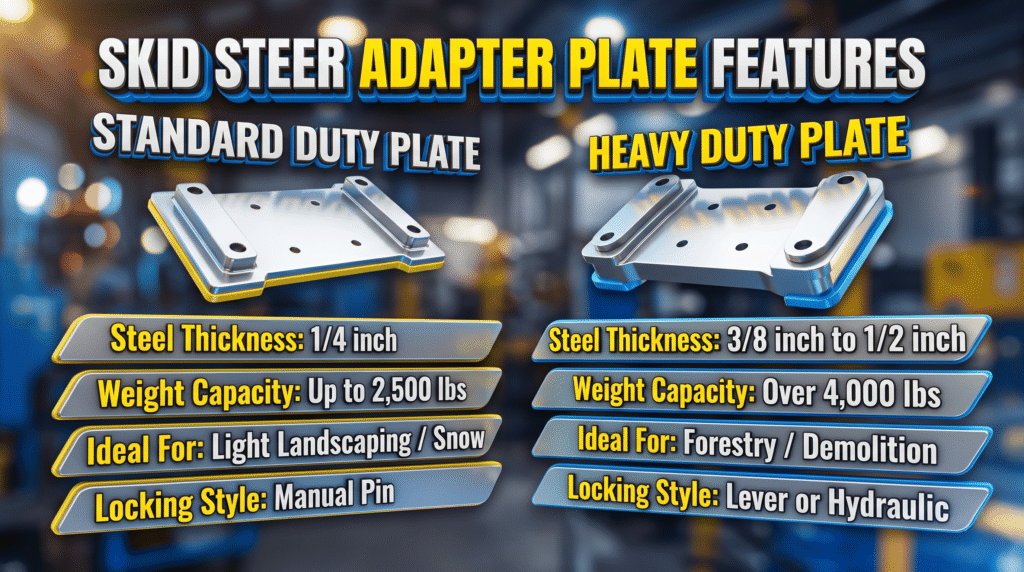
Table: Skid Steer Adapter Plate Features:
| Feature | Standard Duty Plate | Heavy Duty Plate |
| Steel Thickness | 1/4 inch | 3/8 inch to 1/2 inch |
| Weight Capacity | Up to 2,500 lbs | Over 4,000 lbs |
| Ideal For | Light Landscaping / Snow | Forestry / Demolition |
| Locking Style | Manual Pin | Lever or Hydraulic |
Why Your Fleet Needs a Skid Steer Adaptor Plate
Any successful contracting business needs to be efficient. Picture having a barn full of great tractor tools, like 3-point hitch mowers or tillers, that you can’t use because they don’t fit your new skid steer.
You can give your old equipment a new lease on life by putting in a skid steer adaptor plate that is made just for 3-point conversions. This not only saves you thousands of dollars on new attachments, but it also takes up less space in your storage area. You get the strength of a tractor and the ability to move around like a skid steer all in one package.
- Cost Efficiency: It’s much cheaper to buy an adapter than to buy brand-new attachments for each loader you own that are made just for that machine.
- More Use: Machines that can do more jobs stay on the job site longer, which means a faster Return on Investment (ROI).
- Easy to Take Care Of: SteerSkid’s high-quality plates don’t need much care. Just keep the moving parts greased and the locking pins free of dirt.
Different Types of Adaptor Plates and What They Are Used For
What you want to connect has a big impact on which skid steer adapter plate you choose. There are three main types: weld-on plates, bolt-on adaptors, and conversion frames. Weld-on plates are the most permanent option because they let you turn any piece of steel, like a custom snow pusher or a log splitter you made yourself, into a tool that works with a skid steer.
On the other hand, conversion frames, such as 3-point hitch adapters, are meant to be used for a short time. This lets you switch between a tractor and a loader as the season changes.
- Mini to Full-Size Adaptors: These let you use small attachments from machines like the Toro Dingo on bigger loaders, which is great for tasks that need to be done with precision.
- 3-Point Hitch Adaptors: These are great for farmers because they let you attach standard Category 1 or 2 tractor tools to the front of a skid steer for better visibility.
- Blank Weld-On Plates: These are the most popular “DIY” option because they give you a flat surface to weld onto existing buckets or tools made just for your job site.
Putting it together and keeping it safe: Protecting your investment
The skid steer adaptor plate is made to be easy to use with “Quick Attach,” but safety should always come first. Before using, make sure that the locking levers are all the way down and that the pins have gone all the way through the attachment slots.
A loose attachment can not only break the adaptor plate, but it can also cause the machine to fail completely or hurt someone on the job site. At SteerSkid, we stress that a good fit is a safe fit. After putting on an adaptor, always check the routing of the hydraulic hoses to make sure they aren’t pinched or stretched when the loader is moving all the way around.
- Look: Before lifting a load, always walk around the machine to make sure you can see both locking pins and that they are locked.
- Hydraulic Compatibility: Make sure that the flow rate (GPM) of your skid steer is right for the attachment you want to use.
- Weight Limits: The adaptor plate adds weight to your loader, which changes the center of gravity forward. Never go over the Rated Operating Capacity (ROC) of your loader.
Improving Performance with the Right Quality Steel
When it comes to a skid steer adaptor plate, not all steel is the same. Mild steel that stretches under the heavy pressure of hydraulic cylinders may be used in lower-quality imports.
SteerSkid is proud of using grade-50 steel or higher and reinforced mounting points to stop “ear” bending. The adaptor plate is the only thing that keeps your loader’s arms from breaking when you’re pushing a 10-foot snow wing or pulling up concrete with a grapple.
Buying a high-quality plate is a way to make sure that your machine’s hydraulic system will last a long time.
- Stronger Top Lip: To keep the top “hook” of the plate from bending when you pick up heavy loads at an angle, it should be stronger.
- Greasable Pivot Points: High-quality adaptors have grease zerks on the handle mechanisms to keep them from rusting and getting stuck.
- Powder Coated Finish: This finish is strong enough to keep salt, fertilizer, and moisture from corroding the plate, which makes it last for years.
FAQs – Skid Steer Adapter Plate
Are all adaptor plates for skid steers the same?
Not all plates are truly universal, even though most modern loaders use the SAE J2513 standard (Bobcat style). Some “mini” skid steers, like the Toro Dingo or Bobcat MT, have different interfaces. Before you buy, you need to check how your machine is mounted.
Is it possible to use a high-flow attachment with a standard-flow adapter?
The adaptor plate is a part of the structure and does not change the flow of oil. But the attachment must fit your machine’s hydraulic GPM (gallons per minute). The plate just makes sure it fits the loader.
Does a skid steer adapter plate make it harder for me to lift things?
Yes, in a technical sense. For every pound of the adapter plate, you lose a pound of your Rated Operating Capacity (ROC). The plate moves the attachment a few inches forward, which changes the center of gravity a little bit.
How can I tell if I need a plate that I can weld on or one that I can bolt on?
A weld-on skid steer adapter plate is the best and cheapest choice if you have a tool that you only plan to use on that machine. A conversion frame is better if you want to switch attachments between loaders.
Will a 3-point hitch adapter let me use any tractor tool?
Most 3-point adapters work with tools in Categories 1 or 2. But you need to make sure that the implement can be pushed (on a loader) instead of pulled (on a tractor), and that any PTO-driven tools have the right hydraulic motor conversion.
Can you safely use a mini-skid steer attachment on a full-size loader?
Yes, but only if you use the right skid steer adapter plate. But you need to be very careful with the hydraulic pressure because a big loader can easily overpower and break smaller hydraulic cylinders on mini attachments.
Is it possible for me to install a skid steer adapter plate on my own?
It connects like a bucket if it has a quick-attach adaptor frame. You will need professional-grade welding tools and knowledge of penetration techniques to make sure that weld-on plates don’t break when they are loaded.