
1,800 lb to 2,000 lb Capacity Skid Steers | Heavy Lifting Compact Machines
The construction and landscaping industries have experienced a huge transformation in terms of working efficiently, and the 1,800 lb to 2,000 lb capacity skid steer is actually the focal point of this transformation.
These mid-sized machines are the “sweet spot” of the heavy equipment world – they are small enough to navigate tight residential spaces but still strong enough to move large quantities of materials, lift pallets and prepare sites.
Whether you are a contractor or you own a bigger property, learning about these powerful compact heavy-lifting machines will be your first step to increasing your efficiency on the work site.
The Versatility of Mid-Range Skid Steer Capacity
By 1,800 lb to 2,000 lb capacity skid steer, we imply the Rated Operating Capacity (ROC). This implies the maximum weight that the machine can safely carry regularly without risking its stability.
- Accuracy in narrow spaces: These machines are extremely versatile; aside from being able to work the tightest spaces, they also can rotate 360 degrees on their own footprint, so they are perfect for urban construction.
- Proper weight distribution: They have been developed with stability as the main feature, offering a comfortable ride even when working at their maximum loading capacity.
- Extensive attachment compatibility: In this capacity range, you can find particularly high torque attachments such as hydraulic breakers, large augers, and industrial mulchers.
Key Technical Specifications and Performance Metrics
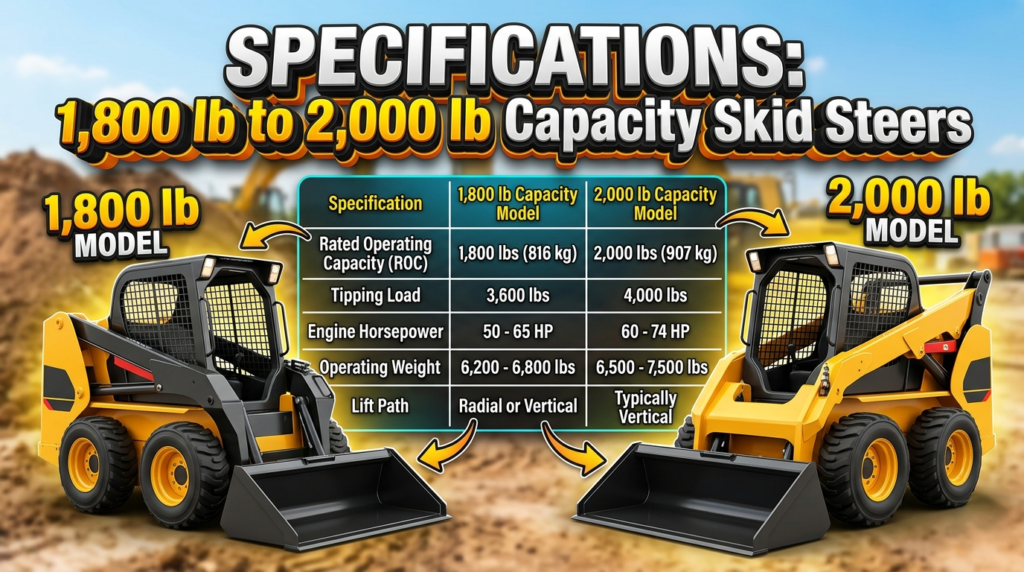
Knowing the difference between Tipping Load and ROC is something that every operator should learn. Usually, for a 1,800 lb to 2,000 lb capacity skid steer, the tipping load is about twice the ROC (roughly 3,600 lbs to 4,000 lbs). This safety margin is so large that even if the machine is on very uneven ground, it should still function properly without tipping over.
Table: Specifications – 1,800 lb to 2,000 lb Capacity Skid Steers
| Specification | 1,800 lb Capacity Model | 2,000 lb Capacity Model |
| Rated Operating Capacity (ROC) | 1,800 lbs (816 kg) | 2,000 lbs (907 kg) |
| Tipping Load | 3,600 lbs | 4,000 lbs |
| Engine Horsepower | 50 – 65 HP | 60 – 74 HP |
| Operating Weight | 6,200 – 6,800 lbs | 6,500 – 7,500 lbs |
| Lift Path | Radial or Vertical | Typically Vertical |
- Vertical Lift vs. Radial Lift: The vertical lift path that is now commonly used will help especially when you need to load the highest side of the truck or when you are stacking pallets.
- Engine Power: You will normally see Tier 4 Final diesel engines delivering high torque at low RPMs, thereby reducing the consumption of fuel.
- Hydraulic Flow: These machines sometimes offer “High Flow” options, enabling you to use very demanding tools like cold planers or stump grinders.
Primary Applications of Heavy Lifting Compact Machines
The main character of a modern-day work site is the 1,800 lb to 2,000 lb capacity skid steer machine. Firstly, it has become a multi-purpose tool for various industries, also demonstrating that it is not necessary to have a huge excavator to get major work done in these situations.
- Commercial Landscaping: These machines can reduce the manual labor by up to 80%. Tasks that usually require a lot of physical effort, such as moving large boulders or transporting heavy sod pallets, can be done quite easily by these machines.
- Demolition and Debris Removal: They can be used for demolition of small structures and loading the debris into dumpsters very efficiently especially when they are equipped with a grapple bucket or hydraulic hammer.
- Agriculture and Farming: Quite useful when there is a need to clean out barns, move hay bales, and undertake fence line maintenance where full-sized tractors can be very cumbersome.
Operator Comfort and Advanced Technology
The modern 1,800 lb to 2,000 lb capacity skid steers have evolved well beyond the standard “iron and oil” stereotype. They have been transformed into highly engineered tools capable of providing the operator ultimate comfort and maximum productivity throughout even the most challenging 10-hour shifts.
- Pressurized Cabs: Modern machines offer sealed, pressurized cabins which keep dust and noise out while enabling climate control;
- Joystick Controls: Operating manual foot pedals is a thing of the past. With the new joysticks electro-hydraulically controlled, the operator can achieve pinpoint precision doing minimum physical work.
- Smart Telematics: Fleet owners will be able to access fuel usage, location and maintenance intervals history and even perform real time monitoring after the installation of these systems, that come with integrated GPS and diagnostic tools.
Maintenance and Longevity of Your Skid Steer
Keeping on schedule with a planned maintenance cycle is absolutely important if you want to continue getting your 1,800 lb to 2,000 lb capacity skid steer to work at top performance level and retain its value.
As these machines are frequently utilized at their lifting capacity limits, it is highly recommended that you routinely inspect not only the hydraulic system but also the undercarriage.
- Daily Fluid Checks: Never forget to measure the engine oil and hydraulic fluid levels at the very beginning of your working day.
- Grease Points: Mid-range skid steers have a lot of pivot points, so if you daily apply grease to these points you will prevent the bucket pins and the bushings from becoming prematurely worn out.
- Tire and Track Care: Keeping tires at correct pressures and track tension at adequate levels is extremely important because these can substantially affect the machine’s capability to perform its rated operating capacity as well as the level of its fuel efficiency.
Why Choose SteerSkid for Your Equipment Needs?
At SteerSkid, our main area of expertise is providing accurate and high-quality information, as well as the best equipment options, for those who are looking for the perfect 1,800 lb to 2,000 lb capacity skid steer.
Our main focus is durability, transparency, as well as assisting you in the identification of the machine that best meets your particular heavy lifting needs.
- Professional Advisor: We assist you in determining the right machine specifications that can address the difficulties of your job site accurately.
- Authentic Parts Support: Compact machinery that stays functional is the top priority of us, and we always ensure our customers get excellent products in replacement parts dealing.
- Industry Expertise: We keep our blog and all other resources up-to-date with the latest in trends regarding compact construction equipment.
Frequently Asked Questions – 1,800 lb to 2,000 lb Capacity Skid Steers
Can a 2,000 lb capacity skid steer lift a pallet of sod?
Yes as a matter of fact. Standard pallets of sod usually load between 1,500 and 3,000 lbs depending on moisture. A 2,000 lb capacity skid steer will be able to safely handle the majority of standard sod pallets; however, caution should be exercised if the sod is very wet.
What is the difference between ROC and Tipping Load?
The Tipping Load is the weight that will actually cause the rear wheels of the skid steer to leave the ground. The Rated Operating Capacity (ROC) refers to a safety-rated fraction (usually 50% for skid steers) of that tipping load so that safe operation is guaranteed.
Do I need a CDL to transport a 1,800 lb capacity skid steer?
Generally, no. These machines usually have weights ranging between 6,000 and 7,500 lbs. With a properly sized trailer, the total Gross Combined Weight Rating (GCWR) is usually below the 26,001 lb limit, which is the lowest for requiring a CDL. Always cross your local regulations though.
Is a vertical lift or radial lift better for a 2,000 lb skid steer?
For truck loading and material stacking, vertical lift is preferred as it gives you more reach at full height. If your work consists mainly of ground-level tasks such as grading or digging, radial lift machines are often longer-lasting and more affordable.
How many hours does a skid steer last?
If properly cared for and maintained, a 1,800 lb to 2,000 lb capacity skid steer can give a working life of 5,000 to 8,000 hours. As the machine ages, the engine and hydraulics will require the most attention among components.
What size trailer do I need for a 2,000 lb capacity skid steer?
Normally, for the safe conveyance of this heavy machine (about 7,000 lbs) plus the attachments and trailer as well, you would need a tandem-axle utility trailer at least having a 10,000 lb GVWR.
Can I use a 1,800 lb skid steer for snow removal?
Yes, definitely. This capacity range is absolutely adequate for snow pushers and snow blowers. The weight of the machine ensures that you have excellent traction, and the hydraulic power is more than enough for high-volume snow moving.