
Commercial Grade Mini Loaders: Ultimate Fleet Solutions for Contemporary Contractors
Nowadays, construction, landscaping, and urban development become more oriented toward efficiency, accuracy, and concentrated power. The continued rise of project densification and escalating labor costs have led contractors to the point where they need commercial grade mini loaders to remain competitive.
These pieces of equipment have ceased to be merely “compact versions” of the usual heavy machinery; instead, they stand as full-fledged powerhouses, capable of delivering outstanding torque output, huge lifting capacities, and highly diversified functions.
Besides vehicle managers, individual contractors also find it advantageous to add these mini loaders on their list of equipment as it is a tactical decision that fulfills the requirement for frequent high-performance while significantly reducing the complexity of hauling large vehicles.
Commercial Grade Mini Loaders – The Choice of Modern Contracting
Commercial grade mini loaders have become so popular lately because they can easily maneuver job sites where normal, large-sized skid steers cannot reach. In addition, they possess the unique feature of having a small footprint, combined with their powerful industrial-strength hydraulic systems, providing operators with the ability to use a wide variety of high-flow attachments such as trenchers, augers, and cold planers.
The emphasis on making these loaders tough and easy to take apart by manufacturers ensures that businesses will get the reliability they need to produce recurring revenue. Besides that, the operator’s work area has been made better with features such as user-friendly joystick controls and wide visibility so that personnel can finish project deadlines with less fatigue.
- Compact Footprint: Easily get through backyard gates, very narrow alleyways, and even indoor demolition sites where a large machine simply will not fit.
- High Hydraulic Flow: Have been designed to encompass plumbing that is capable of working with a diverse range of professional-grade attachments converting one machine into a multi-tool for a variety of contracts.
- Reduced Ground Pressure: Perfect for sensitive landscaping efforts where maintaining the quality of the turf or soil is paramount.
Fleet Utility Maximizing Versatility and Attachment Integration
Commercial grade mini loaders come loaded with features that one can hardly count in a day. The possibility of changing a soil-moving bucket for a hydraulic pallet fork or a snow blower without much hassle can open up a whole new market for operators.
The minic Chair made it less a need for a single-purpose machine, and the total cost of ownership has gone down significantly. Speaking of contractors carrying out utility operations, when it comes to digging narrow trenches for fiber optics or water lines, mini loaders offer a much greater level of accuracy than large excavators because the “over-dig” and resulting restoration costs are kept to a minimum.”
- Quick-Attach Systems: Offer ability to change between buckets, forks, and special tools quickly as machine is hardly ever idle.
- Multi-Industry Application: Suitable for work like tree service and forestry as well as site prep and concrete demolition.
- Precision Control: Hydraulic systems that have been fine-tuned provide for delicate operations alongside existing structures or underground utilities thereby minimizing damage risk.
Fleet Efficiency Optimization with Mini Loader Solutions
Running a fleet for a big contractor is significantly about knowing how to balance uptime with transportability. You will find that commercial grade mini loaders take up much less space at transport than their big brothers, and for the most part will only necessitate a standard pickup truck and a trailer instead of a heavy-duty commercial hauler.
Such logistics flexibility means that a contractor is even capable of deploying several units at different sites almost simultaneously thereby enhancing labor efficiency to the maximum.
Furthermore, these compact machines operate on lower fuel resulting in an overall environmentally friendly footprint, something that aligns perfectly with reducing overhead costs although the machines never compromise on the huge lifting force they can provide or grading.
- Ease of Transport: Lower weight and smaller sizes allow for faster mobilization and reduced fuel prices for vehicles tasked with transporting.
- Low Operating Costs: Efficient engines and simplified maintenance routines help keep cost-per-hour at profitable levels.
- Scalability: Small crews can produce output comparable to large crews by using compact loader’s mechanical advantage for material handling.
Commercial Grade Equipment Durability Standards
Where commercial grade mini loaders stand apart from entry-level or residential ones is their focus on durability which is often the determining factor when making a purchase decision.
These machines come equipped with steel frames that have been reinforced, heavy-duty bush pins, and protected hydraulic lines which help avoid downtime due to environmental hazards. Contractor fleet solutions should be made up of machines that work around the clock for 8–10 hours even under extreme temperatures and dusty conditions. High-end mini loaders are with serviceability-first designs meaning that engine components and filters are exposed for easy daily inspections thus the machine is more likely to stay in field than in the shop.
- Reinforced Structures: Heavy-gauge steel frame construction makes the machine capable woman handling the stresses of heavy prying and lifting.
- Protected Components: Hydraulic hoses and electrical harnesses are either internally routed or shielded so as to be damage-proof from debris.
- Extended Service Intervals: Comes with the design aspects of long-lasting fluids and high-capacity filters that reduce the necessity for frequent maintenance to a bare minimum.
Reasons Why Contractors Choose Specialized Mini Loader Fleets
Contractors Firms are moving toward specialized fleets since the “one size fits all” philosophy for heavy machinery can no longer be found in a world of high-density construction.
Commercial grade mini loaders deliver a particular power-to-weight ratio that permits high-speed operation even in cramped spaces. They are especially popular in urban areas where lane and sidewalk closures are very restricted.
By purchasing these machines, contractors can do a wider range of jobs, from landscaping in residential communities to repairing municipal infrastructures, all the while being confident their equipment is properly sized for the job at hand.
- Urban Adaptability: Great for downtown projects where space is a major issue and noise ordinances may be present.
- Enhanced Visibility: The operator usually has a 360-degree view of the job site, significantly increasing safety in congested work areas.
- Operator Comfort: Contemporary models come with suspension seats and options for climate control which are very helpful in keeping skilled operators.
Mini Loader Specifications Comparison for Fleet Management
Investing in the correct loader involves analyzing the technical details very carefully so as to determine if the machine will satisfy the specific requirements that the contractor is faced with in the performance of his/her typical duties.
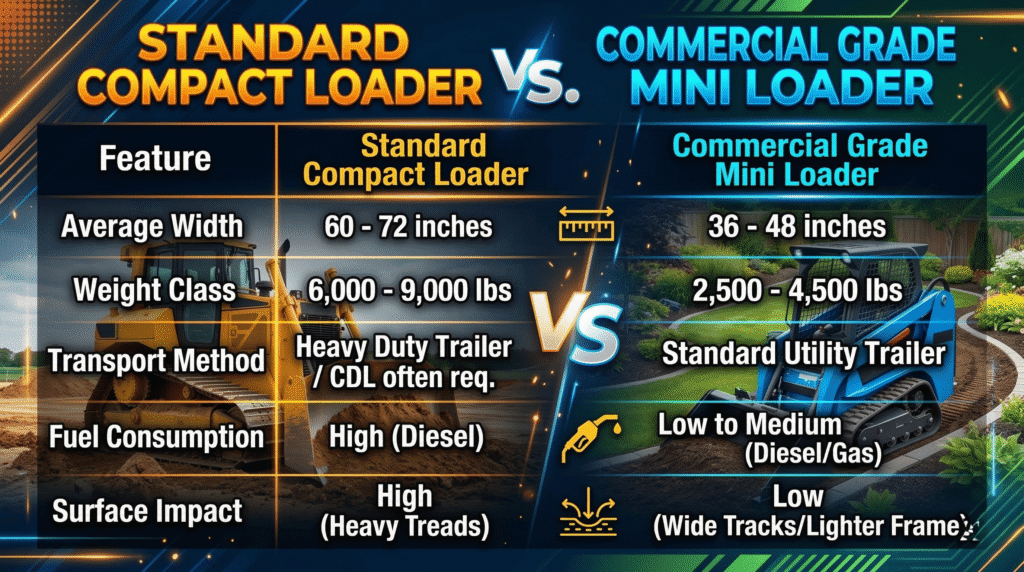
Parameters such as Rated Operating Capacity (ROC), tipping load, and engine horsepower must be taken into account along with the physical dimensions of the machine. Usually, seeing a side by side comparison will give fleet managers a quick overview of whether mini loader can effectively substitute a larger skid steer without any major loss in productivity.
Table: Compare Standard Compact Loader Vs. Commercial Grade Mini Loaders
| Feature | Standard Compact Loader | Commercial Grade Mini Loader |
| Average Width | 60 – 72 inches | 36 – 48 inches |
| Weight Class | 6,000 – 9,000 lbs | 2,500 – 4,500 lbs |
| Transport Method | Heavy Duty Trailer / CDL often req. | Standard Utility Trailer |
| Fuel Consumption | High (Diesel) | Low to Medium (Diesel/Gas) |
| Surface Impact | High (Heavy Treads) | Low (Wide Tracks/Lighter Frame) |
Sustainable Practices and the Future of Compact Equipment
As striper regulations become more and more stringent, the importance of commercial grade mini loaders in influencing sustainable contracting also goes up. A good number of these machines have been equipped with Tier 4 Final engines that dramatically reduce emissions.
Besides that, the beginning of the release of the electric mini loaders commercial machinery provides for no-emission operation that is perfect for indoor and/or underground jobs. Contractors who are well-informed on future trends and have decided to merge this kind of modern and efficient mini loaders into their fleet are not only making a profit from their decision but they are also ensuring the existence of their business in a changing environment.
- Reduced Emissions: Thanks to modern engines, the machines easily comply with strict environmental standards while still being powerful in torques.
- Lower Noise Pollution: This is a necessary feature when working near residential neighborhoods, hospital zones, or school districts where noise levels must be kept low.
- Tier 4 Compliance: It indicates that the fleet is eligible to be on government and municipal contracts which require green equipment.
Frequently Asked Questions (FAQ) – Commercial Grade Mini Loaders
What is the difference between a standard skid steer and a commercial grade mini loader?
Generally speaking, a standard skid steer is a bigger and heavier machine that is mainly used for mass handling of earth materials. On the contrary, a commercial grade mini loader is a very compact piece of equipment and therefore it is extremely easy to transport it. Besides that, it is primarily designed to be able to carry out a great variety of very precise tasks in very confined places but it can still give an operator the same power as the hydraulic systems of larger machines.
How much weight can a mini loader typically lift?
Commercial grade mini loaders have a Rated Operating Capacity (ROC) usually ranging from 500 lbs to 2,000 lbs depending on the model. However, one should always verify the specific tipping load of the unit before any operation is carried out.
Are mini loaders better on tracks or wheels for construction sites?
Commercial construction sites with soft or uneven surfaces are usually equipped with tracked machines because they provide better stability, have a lower ground pressure, and on top of that, they offer better traction in mud and similar conditions. Wheels on the other hand are a more suitable option for hard surfaces such as asphalt or floorings of concrete used in order to minimize tire wear.
Can mini loaders use the same attachments as full-size skid steers?
The majority of mini loaders utilize what is termed as a “Universal Mini Mount” which is in fact smaller than a full-size skid steer plate. But there are also adapters available in the market and many manufacturers nowadays are offering a wide range of high-performance attachments that are “mini-specific”.
Is a special license required to operate a mini loader on a job site?
Normally, a regular driver’s license is sufficient for a person to operate a mini loader on private properties but obtaining proper OSHA training and certification is definitely a must for any sort of commercial operating as it ensures the safety aspect of the operation.
What are the maintenance requirements for a fleet of mini loaders?
Hydraulic fluid, engine oil, and track tension should be checked on a daily basis. Given that these machines are subjected to extremely rigorous working conditions in commercial environments, greasing of points is necessary every day to avoid premature wearing.
How do mini loaders improve the ROI for contractors?
Mini loaders help lower labor costs by automating actions that used to be manual (like the use of wheelbarrows), transport expenses are also reduced and contractors can get hold of jobs with access constraints that the others can not fulfill thus expanding their scope.