
How to Cut Skid Steer Maintenance Costs Without Trading Quality?
Investing in a skid steer can transform your construction, landscaping, or agricultural business. Such machines, compact yet mighty–for example, the TYPHON series by Steer Skid–have a wide range of applications from trenching to lifting and moving hefty loads. That said, besides the initial price of heavy machinery, which is certainly not negligible, there are other costs such as operating costs that primarily concern maintenance. Without a proper strategy, these costs can take up a substantial portion of your income. The real challenge for most entrepreneurs is finding a budget-friendly method that doesn’t adversely affect the life and performance of the machine.
It is a misconception that one can reduce maintenance costs by neglecting oil changes or warning signs. Indeed, such negligence usually leads to a failure of equipment which in the end will cost you thousands more.
The point is not to save money on maintenance but to change your mental approach: to stop reacting and start being proactive. discipline in regular maintenance, knowledgeable training of operators, and wise decisions in the selection of parts and fluids will help you decrease the overall expense of ownership by a significant margin and still maintain a skid steer as good as new.
Discipline in following Preventative Maintenance Schedule Down to the Minute
The best method by far to cut maintenance costs in the long-run is to diagnose and address small issues early. A preventative maintenance (PM) schedule is not simply a guide line that manufacturers suggest; it’s a tool to financially protect your business. When you skip a service, pretending that you are saving money or that you need to keep running, you are in truth taking a loan that you will repay with high interest through later repairs which will be costlier than timely maintenance.
For one thing, a dirty air filter can harm your engine power and fuel consumption, not to mention cause severe damage to the engine system over time. While replacing a filter barely costs anything, an engine rebuild will set you back thousands. Your cleaning and maintenance routine should be centred around machine operating hours, which usually are 10, 50, 250, 500, and 1000 hours.
- Preoperative Visual Inspection: Operator is supposed to check hoses for oil stains or cracks, tire conditions and loose parts.
- Maintenance of Fluids: ensure timely and regular changes of oil, hydraulic fluid, and coolant in accordance with the manufacturer’s recommendations. Old fluid loses its efficacy and protective properties.
- Grease, Not Steel: apply lubricant to parts of a loader that have the most contact with the metal so that the loader arms, and buckets do not be damaged by abrasion caused by metal-to-metal contact.
Reduce Skid Steer Maintenance Costs by Training Operators Properly to Lower Wear and Tear
It is quite possible that the maintenance team has all the right tools, however, if an operator recklessly drives the machine, then the costs will go through the roof. An operator who shorts the life of the power train and the structural parts by dirty tricks like, tires spinning out of control, slamming the bucket on the ground, and constantly changing directions, must be disciplined.
Teaching your operators to operate the machine in a safe manner is one of the cheapest methods of saving money that is seldom considered. A well-trained operator uses the machine effectively and finds ways of doing it with minimum exertion. The latter saves the fuel and extends the longevity of tires, tracks, and hydraulic pumps. Consider implementing a reward system for operators who consistently pass daily inspections without inducing avoidable damage.
- No Counter-Rotation: 360-degree spinning on-the-spot tearing tires and causing tracks to wear out rapidly; help operators to make 3-point turns instead.
- Warm-Up and Cool-Down Procedures: give the engine and hydraulics time to reach the correct temperature by operating at lighter loads initially; and let the engine idle for a moment before shutting down so the turbocharger can cool off.
- Load Management: teach operators to not overwork the machine beyond its rated capacity as this causes the hydraulic system to be stressed and results in the bending of the loader arms.
Mastering Undercarriage and Tire Management
Undercarriage or tire set in skid steers and compact track loaders represents a major part of the consumable costs. A skid steer differs from a car in that the latter can rotate freely whereas the former has to drag its wheels or tracks when turning thus creating friction all the time. You may be forced to change expensive rubber much more often if you ignore the undercarriage.
Maintaining right tire pressure is equally important for those on wheels. An under-inflated tire will bend excessively, heat up, and later develop cracks on the sidewall while an over-inflated one will be easily damaged by cuts or impact. For track loaders, the emphasis is more on tension. A track that is too loose risks slipping off (de-tracking) while that which is too tight will quickly wear out rollers and sprockets.
- Picking Proper Tire/Track: block treads should be used for hard surfaces like asphalt to lower tire wear and bar treads should be used for loose dirt to prevent wheels spinning without gaining traction.
- Tire Rotation: similarly to a car, the wear on skid steer tires on one side is more than on the other; thus, rotating tires enables a longer average life span for the entire set.
- Remove Dirt and Stones: after each day’s work, clear out mud and stones from the undercarriage to stop seals from getting damaged by the abrasive action of these foreign materials.
Efficient Fluid Management Leads to a Healthier Skid Steer at a Lower Cost
Fluids are indispensable to your skid steer. In addition to allowing parts to move smoothly, engine oil, hydraulic fluid, and coolant also perform the functions of cleaning, cooling, and sealing of the internal components. The majority of equipment owners take a cheap way out by buying the least expensive generic fluids; however, in the long run, this will cost them more. Good-quality fluids have well-formulated additive packages that help them retain their properties under heat and pressure which is especially high in compact equipment.
In addition, a fluid analysis program will be of great benefit to you. Take a small sample of your oil or hydraulic fluid during changes and send it to a lab. That is where the secrets of the inside of your engine will be revealed. For example, a high concentration of metal shavings indicates the wear of bearings whereas coolant present in oil suggests that the head gasket is about to fail. The reaction to such warning signs should be quick to fix a small part instead of a major system.
- Meet the Requirements: pay attention to the viscosity grade and API rating that are specified in your owner’s manual (for example, the TYPHON skid steer loader requires a certain type of hydraulic fluid).
- Keeping Something Clean: dirt is the worst enemy of the hydraulic system; thus, before removing the filler cap, the area around it should be wiped thoroughly.
- Routine Liquid Level Inspection: a leak is indicated most times by a sudden drop in fluid level and it should be attended to immediately; otherwise, the system will run dry and overheat.
The Role of High-Quality Attachments
In working with your skid steer, its capability is determined by whatever attachment is connected. Opposing factors such as old, broken, or incompatible attachments will exert unnecessary force on a machine’s hydraulic system. For example, if a hydraulic breaker requires more flow than the machine can provide, the pump will be overworked and overheat. Alternatively, dull bucket teeth perform poorly and require more power to dig, which means an operator will have to keep ramming the dirt and increase the engine RPMs.
When you buy an attachment, you should check whether it is designed for the type of machine you have. Skid steer maintenance ensures that their attachments are perfectly matched with the machines they accompany thereby lowering the risks of incompatibility. Attachments should be properly maintained as main machines are–pin greasing, hose checking, and wear part replacements such as the cutting edges and teeth.
- Matching of Flow Rates: only use high-flow attachments with high-flow machines to avoid damage to the hydraulic system.
- Test Hydraulic Couplers: as these are the parts through which the majority of fluid contamination enters the system, they should be inspected for damage and cleaned regularly.
- Wear Part Replacement: by changing the bucket teeth regularly, not only will your digging be easier but you will also save fuel and reduce the wear of the engine.
Proper Storage and Seasonal Care
The way you store your equipment when it is not in use has a significant impact on the amount of time and money you have to spend on maintenance. When a skid steer is left exposed to the elements, its components such as hoses, seals, paint, and electrical connections will wear out much faster. For example, UV rays dry out hydraulic hoses and eventually they become so brittle that they burst; on the other hand, moisture causes corrosion of electrical terminals and this leads to phantom starting problems.
If you don’t have a garage, then you should buy a high quality, heavy-duty, and sturdy tarp or custom cover. During the cold season, use a block heater to reduce the stress on the engine caused by cold starts. Also, treat the fuel with an anti-gel additive. For long-term storage, disconnect the battery and fill the fuel tank to the top to prevent condensation inside.
- Battery Maintenance: cold weather is the enemy of the battery so it should be kept charged and the terminals cleaned for easy starts.
- Protect Hydraulic Rods: if a machine is not to be used for a long period, whether it is indoors or outdoors, the hydraulic cylinders must be completely retracted and the chrome exposed rods coated with grease to prevent rust pitting.
- Operate Periodically: running up the engine after a period of time will help replace the oil and keep the seals lubricated even if the machine is only used seasonally.
DIY vs. Professional Service: Knowing Your Limits
In general, the easiest way to save some money would be to do all the skid steer maintenance on your own. Keeping up with daily checks, greasing, and fluids change in-house is excellent for saving money and very efficient. However, knowing the right time to call a professional is a big part of the game as far as maintenance is concerned. TYPHON skid steers, for instance, have complex electronics as well as tight hydraulic tolerances.
Doing complex tasks such as rebuilding a hydraulic pump or troubleshooting the ECU error code with no proper diagnostic tools is bound to failure. That will definitely cost you at least twice more than if a professional had done it in the first place. In fact, the specialists can usually spot the problems even before they happen.
- Manage Simple Tasks: changing your own air filters, engine oil, and grease fittings will be a nice way to lower labor costs.
- Diagnostics Outsource: warning lights that directly affect the engine computer or hydrostatic drive should be handed to a certified mechanic.
- Documentation is a must: make a record of all repairs and maintenance regardless of who performed them, as this will help you maintain the resale value.
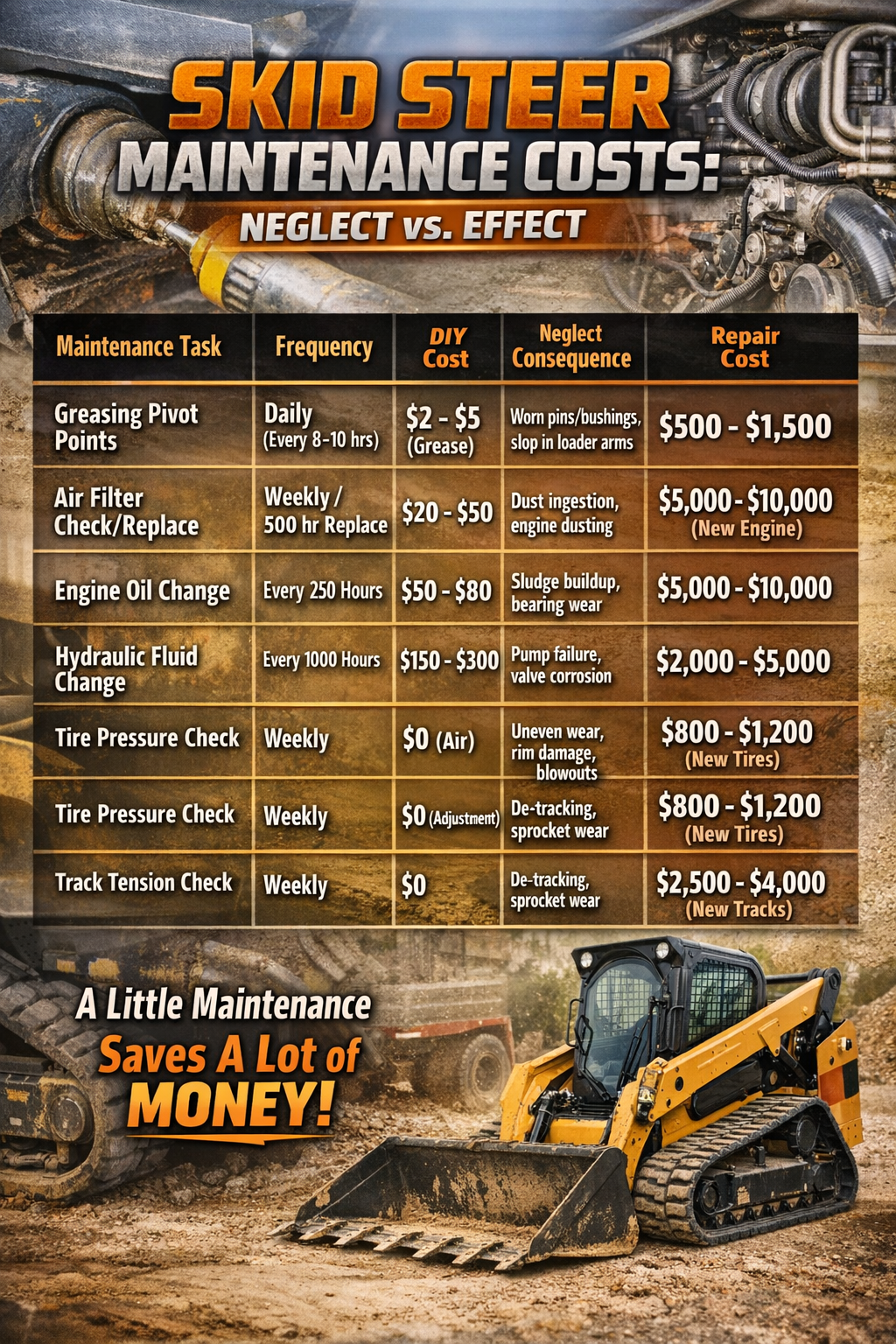
Skid Steer Maintenance Costs Reduction Chart
Below is an illustration of what typical skid steer maintenance costs may include, where the biggest cost is, and what portion of it you could potentially save.
Table: Skid Steer Maintenance Costs
| Maintenance Task | Frequency | Estimated DIY Cost | Consequence of Neglect | Potential Repair Cost |
| Greasing Pivot Points | Daily (Every 8-10 hrs) | $2 – $5 (Grease) | Worn pins/bushings, slop in loader arms | $500 – $1,500 |
| Air Filter Check/Replace | Weekly Check / 500 hr Replace | $20 – $50 | Dust ingestion, engine dusting | $5,000 – $10,000 (New Engine) |
| Engine Oil Change | Every 250 Hours | $50 – $80 | Sludge buildup, bearing wear | $3,000 – $8,000 |
| Hydraulic Fluid Change | Every 1000 Hours | $150 – $300 | Pump failure, valve corrosion | $2,000 – $5,000 |
| Tire Pressure Check | Weekly | $0 (Air) | Uneven wear, rim damage, blowouts | $800 – $1,200 (New Tires) |
| Track Tension Check | Weekly | $0 (Adjustment) | De-tracking, sprocket wear | $2,500 – $4,000 (New Tracks) |
Skid Steer Maintenance – FAQs
What is the right time to change the hydraulic fluid in the skid steer?
Hydraulic fluid replacement should generally take place every 1,000 hours of use following manufacturer advice. Exposure to very hot and dusty environmental conditions might necessitate more frequent changes (e.g., every 500 hours). Checking the fluid’s color is always the best practice, and if it’s milky (indicating water contamination) or gives off a burnt odor, change it immediately, regardless of the number of hours.
Is it okay to use regular car engine oil in the diesel motor of a skid steer?
Naturally, the answer is no. A diesel engine, typically found in a skid steer, is subjected to considerably higher pressure and stress than that of a gasoline-powered car. If you want to comply with the owner’s manual, you have to use a diesel engine oil of heavy duty quality (normally 15W-40) with an appropriate API service classification, e.g., CK-4, CJ-4. Car oil can deteriorate quite fast and cause engine failure.
Which is the average yearly maintenance expense of a mini skid steer?
Mini skid steer such as TYPHON STOMP is estimated to cost not more than $1,200 per year under normal use of 300-500 hours. The budget will include the cost of fluids, filters, grease, wear, and tear parts as well as light repairs. Tire replacement will be considered an extra cost to the above figure. Maintenance done by yourself will keep the figure closer to the bottom of the range.
What are some tips to make skid steer tires last longer?
Among the tips to prolong the tire life is to avoid making the counter-rotating (spinning in place) move all the time. The right thing to do here is the wide 3-point turns. Also, keep tire inflation levels to the manufacturer’s specifications. In case of working mainly on the concrete, consider buying hard-surface tires; if it’s mud, then bar-lug tires are the choice. Rotating tires from front to back is yet another method for uniform wear.
Which kind of skid steer has lower maintenance cost: Gas or Diesel?
Normally, Gas skid steers have lower maintenance costs because they don’t have complex fuel injection systems, turbochargers, and emission controls (like DPF filters) that are present in diesels. On the other hand, diesel engines are built with longer service lives and are capable of delivering more torque. If you only have a small size operation or occasional usage, a gas model TYPHON 13.5hp or 23hp, can be very cheap to maintain.
What are the reasons for my skid steer losing power when lifting?
Usually, a power loss sensed when lifting points either to a hydraulic problem or a clogged fuel filter. Start with the level of hydraulic fluid and the state of the hydraulic filter. When the filter is clogged, the pump cannot get enough fluid. On the other hand, if the engine is losing power, check the fuel filter and air filter. If both are clean, then it is highly likely that the hydraulic pump is worn and consequently losing pressure.
What are the effects of storing a skid steer outside?
The answer is yes that it will be damaged as time goes by. Constant exposure to sun rays, rain, and cold and heat changes will cause rubber hoses and seals to wear out, paint to fade, metal to rust, electrical components to corrode. If it is only possible to store it outside, take your machine under a waterproof cover of high quality, and try to park on gravel or concrete instead of grass to reduce moisture rising from the ground.
Final Verdict – Skid Steer Maintenance Costs
It is not about psing maintenance budget to bare minimum when talking about cutting down your skid steer maintenance cost but it is about utilizing the knowledge wisely. If you closely follow your scheduled maintenance agenda, you’ll receive a substantial discount from your monthly operating costs in return. In addition, operators that are well-trained in machine handling not only respect the equipment but also are able to identify issues at an early stage and get the help in time to prevent a breakdown.