
Hydraulic System Troubleshooting: Common Skid Steer Problems Solved
Great hydraulic system troubleshooting actually helps you understand the right time when your work needs to be interrupted for repair. Skid steer owners, the hydraulic network is literally the heart of the entire machine.
After you’ve tried everything successfully with your loader but losing power, overheating or even acting strangely, a good work through hydraulic system troubleshooting will show whether it’s only a clogged filter problem or it is a broken pump. At SteerSkid, we are always at the forefront to support operators to master hydraulic system troubleshooting so that they can rely on their machines even in the most difficult situations.
The Importance of Early Hydraulic System Troubleshooting
The key to successful hydraulic system troubleshooting is to identify the signs of mechanical problems as early as possible. A lot of times, operators make the mistake of operating a machine until it is completely down but in reality, early hydraulic system troubleshooting can make those little leaks that are bothering you a minor inconvenience rather than the cause of a totally contaminated system.
- Audible Warnings: During hydraulic system troubleshooting, one of the major signs of air ingress is whining or growling noises.
- Temperature Spikes: Keeping an eye on the heat is one of the main steps of hydraulic system troubleshooting as excess temperature often indicates internal bypass.
- Operational Lag: When the lift arms move with delay, the main focus of your hydraulic system troubleshooting has to be pressure loss or suction leaks.
- Visual Fluid Inspection: One of the essential steps of hydraulic system troubleshooting to detect water or heat damage is to check if the oil has a milky or burnt appearance.
Hydraulic System Troubleshooting for Slow Lift and Tilt Functions
Most of the time when a skid steer does not have enough power to operate a full bucket, the hydraulic system troubleshooting will point to pressure control elements. This specific area in hydraulic system troubleshooting makes sure that the flow is pushed to the cylinders instead of leaking back to the reservoir.
- Relief Valve Testing: A huge part of hydraulic system troubleshooting is the troubleshooting of the main relief valve to see if it is stuck open, thus continuously releasing pressure.
- Cylinder Seal Assessment: During hydraulic system troubleshooting, if the arms “float” down, it is the internal piston seal bypass in the hydraulic system that is the culprit.
- Pump Output Verification: To be able to perform competent hydraulic system troubleshooting, you will need to measure the pump’s GPM (Gallons Per Minute) to see if it is producing the amount specified by the manufacturer.
- Fluid Level Consistency: For the first step in hydraulic system troubleshooting to always check the sight glass; insufficient oil is an often reason of power loss.
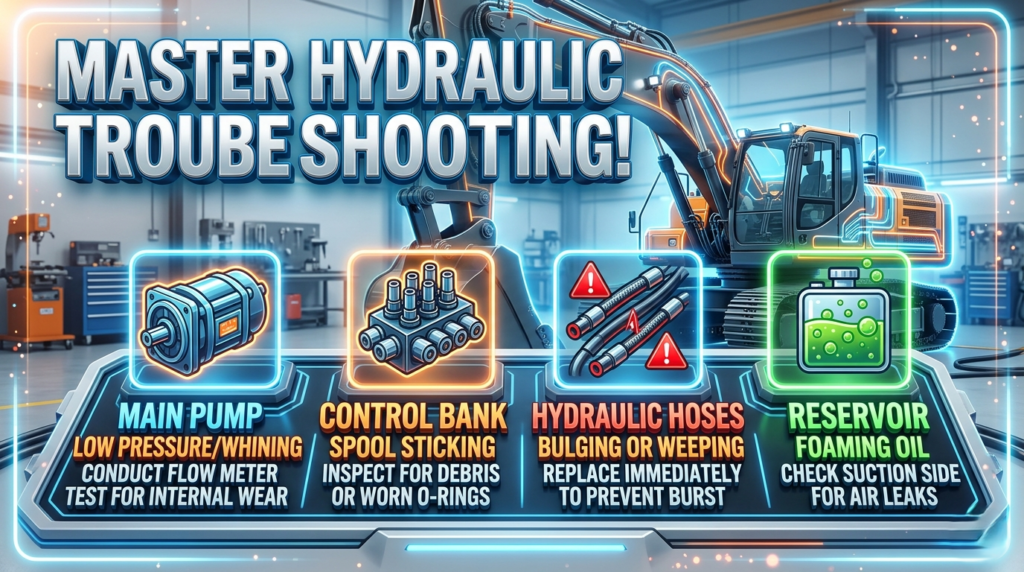
Table: Hydraulic System Troubleshooting Components
| Component | Trouble Symptom | Hydraulic System Troubleshooting Action |
| Main Pump | Low Pressure/Whining | Conduct flow meter test for internal wear |
| Control Bank | Spool Sticking | Inspect for debris or worn O-rings |
| Hydraulic Hoses | Bulging or Weeping | Replace immediately to prevent burst |
| Reservoir | Foaming Oil | Check suction side for air leaks |
Managing Overheating via Hydraulic System Troubleshooting
Hydraulic system troubleshooting often targets overheating problems, which are a frequent cause of hydraulic system failure. When [hydraulic] oil is overheated, it loses its viscosity. This problem complicates hydraulic system troubleshooting as the symptoms become erratic and inconsistent.
- Cooler Obstructions: Thorough hydraulic system troubleshooting shows that dust accumulated in the radiator fins is the biggest cause of heat.
- Fan Motor Function: Doing hydraulic system troubleshooting on high-temperature alarms, measuring the airflow of the cooling fan to ensure it’s sufficient is a routine step.
- Bypass Valve Calibration: When the engine is hot, but the oil is cold, then hydraulic system troubleshooting indicates a broken thermal bypass valve.
Hydraulic System Troubleshooting for Drive Motor Issues
After paying attention to the symptoms of a machine driving to one side, your hydraulic system troubleshooting has to change course by moving from the implement circuit to the hydrostatic drive circuit. Since this part of hydraulic system troubleshooting involves extremely high pressures, it is regarded as being quite technical.
- Case Drain Inspection: Expert hydraulic system troubleshooting involves checking the case drain filters to keep the drive motor seals safe.
- Drive Chain Tension: At times, hydraulic system troubleshooting points out that the issue lies in the mechanical part that is the drive chain (too loose) rather than the hydraulic part.
- Neutral Centering: When the machine moves on its own, hydraulic system troubleshooting should consider the control linkages and centering springs.
A Checklist for Preventative Hydraulic System Troubleshooting
Hydraulic system troubleshooting can be so efficient when you do not even have to stop to think about it. If you follow a consistent procedure, your hydraulic system troubleshooting transforms from an emergency response into a regular habit.
- Daily Inspections: Keep an eye out for spots on the ground that are wet with fluid; this very simple hydraulic system troubleshooting step can help locate leaks early.
- Filter Schedules: Regular filter changes are the “preventative” type of hydraulic system troubleshooting that helps keeping the valves free of contamination.
- Fluid Sampling: Analyzing oil in a laboratory is a very hydraulic system troubleshooting advanced technique that enables the discovery of tiny metal shavings.
Table: Hydraulic System Troubleshooting Benefits
| Task | Category | Hydraulic System Troubleshooting Benefit |
| Bleeding Air | Maintenance | Prevents “spongy” control feel |
| Hose Routing | Inspection | Prevents rubbing and premature failure |
| Pressure Setting | Calibration | Ensures maximum breakout force |
| Oil Sampling | Diagnostic | Predicts component failure before it happens |
FAQ: Common Hydraulic System Troubleshooting Questions
Why is my skid steer hydraulic fluid milky during troubleshooting?
During hydraulic system troubleshooting, milky fluid indicates contamination by water. Besides, it is a severe case that the system must be completely flushed in order to eliminate rust on the internal surfaces of the pump.
How do I troubleshoot a noisy hydraulic pump?
Begin your hydraulic system troubleshooting by examining the suction line for air leaks. If air gets in, the pump cavitation results in a loud, metallic, whining noise.
What is the first step in hydraulic system troubleshooting for loss of power?
Checking the fluid level and looking at the condition of the hydraulic filters is the first step in hydraulic system troubleshooting. In most cases, power problems are caused by restricted flow.
Can hydraulic system troubleshooting identify a bad drive motor?
By using the hydraulic system troubleshooting method of elimination, if the pump pressure is perfect but the machine is not moving, then the internal drive motor seal failures are most likely the problem.
How does heat affect hydraulic system troubleshooting?
The oil viscosity decreases when it is hot. Therefore, performing hydraulic system troubleshooting on a cold machine may not uncover the leaks which appear once the machine reaches its operating temperature.
Is a vibrating hose a sign I need hydraulic system troubleshooting?
Yes, vibrating or “jumping” hoses can be a sign of pressure spikes or air pockets, and that means you need a hydraulic system troubleshooting without any delay to keep a hose bursting.
Why do my controls feel stiff during hydraulic system troubleshooting?
Hydraulic system troubleshooting detects that stiff controls mainly indicate either loss of pilot pressure or fouling of the control valve spool with debris.