
Trencher vs. Auger: Which Skid Steer Attachment Do You Need?
Choosing the right equipment for your job can make a big difference between a successful finish and a frustrating, expensive delay. In the realm of excavations and earth-moving operations, TYPHON STOMP Mini Skid Steer owners often debate between the skid steer attachment Trencher vs. Auger as their next purchase or rental.
Despite both attachments being designed to break the surface of the ground, their functions and environments of use could not be more different. Knowing how each tool works, what they can achieve and where you can get the best results from them will guarantee you get the most work done in the shortest time with your machine.
Whether your trade is installing underground utility lines or you are just a homeowner with plans to spruce up the backyard, deciding which attachment to rent or buy could be your project’s gamechanger.
In simple terms, a trencher is like a giant chainsaw for the ground and an auger is a high-powered drill. We will discuss them in detail in this guide to help you make a clear decision on which skid steer attachment best suits your upcoming project.
The Mechanics of the Skid Steer Trencher
Precisely, a trenching skid steer is a machine for the quick creation of long and narrow trenches. This is done using a tough chain equipped with cutting teeth which is continuously moving around a metal boom.
When the skid steer is moving backwards, the trencher slices the soil and takes out the dirt which it deposits aside by means of a waste auger. The result is a neat and regular trench suitable for laying of pipes and electrical cables etc.
In terms of covering ground, the trencher can hardly be beaten in the length department. No need for a ditching bucket or going hole by hole with a shovel, the trencher will keep both depth and width steady throughout the length of the trench and this means less backfilling after.
If you already own a TYPHON STOMP 1,600lbs Mini Skid Steer, then a trencher adapter is sure to turn your week of hard and tedious manual labor into a matter of hours of machine work only.
- Continuous Channels: Useful for projects like irrigation or electrical conduits that require long, straight lines.
- Depth Control: Most trenchers provide an adjustable feature of trench depth to vary from 24 to 48 inches based on customer requirement.
- Spoil Management: A trenching auger along the machine essentially does the double job of extracting dirt to one side while ruling out spillage of trench dirty allowing pipe laying to be done immediately.
Understanding the Skid Steer Auger
On the contrary, the auger can be considered as a precision-drum for a power tool like the trencher. The main parts of a skid steer auger attachment are a hydraulic motor head and a spiral-shaped bit. Its key feature is drilling precisely vertical holes in the ground. Augers vary mainly in diameter from small 6″ bits for fence posts to huge 30″ bits for planting trees or making foundation piers.
The major benefit of an auger in the Trencher vs. Auger dispute is that it produces very deep and concentrated holes without affecting the adjacent soil. Working with the TYPHON STOMP 2,000lbs Mini Skid Steer, the user can rely on the machine’s hydraulic power which transfers enough torque to the auger to allow breaking of hard clay or even a rock that otherwise wouldn’t be dug manually. For vertical jobs imposing requirements such as stability and high precision, this is the best tool choice.
Tool Choices are:
- Vertical Precision: The post hole requirement for homes, barn decking, and poles is made easy with a hole-driller.
- Diameter Variety: With this type of system, one can utilize a very narrow post hole bit as well as a wide hole planter for a tree within minutes just by changing the bit.
- High Torque: This auger is capable of high torque thus allowing operation in situations of highly resistant ground such as compacted dirt and ground with small rocks etc.
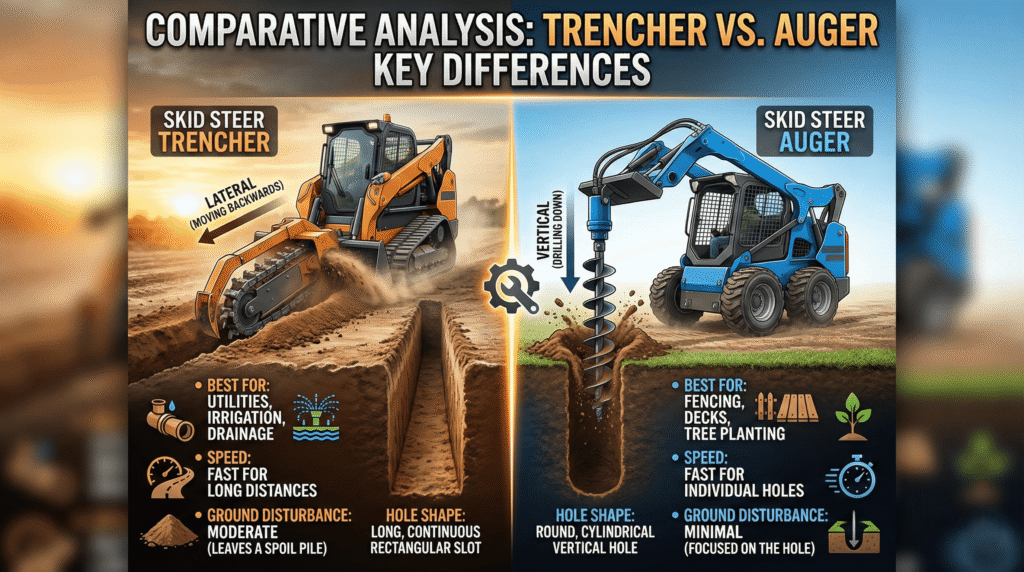
Comparative Analysis: Skid Steer Attachment – Trencher vs. Auger
| Feature | Skid Steer Trencher | Skid Steer Auger |
| Primary Motion | Lateral (moving backwards) | Vertical (drilling down) |
| Hole Shape | Long, continuous rectangular slot | Round, cylindrical vertical hole |
| Best For | Utilities, irrigation, drainage | Fencing, decks, tree planting |
| Speed | Fast for long distances | Fast for individual holes |
| Ground Disturbance | Moderate (leaves a spoil pile) | Minimal (focused on the hole) |
When to Choose a Trencher for Your Project
When underground installations are the focus of your project, then a trencher is a wise choice. A trenching machine would be best for running fiber optic cables through commercial buildings or laying out a sprinkler system on a golf course.
No doubt the trencher will provide you with speed and uniformity to a degree that a power auger simply cannot match for those projects which require linear work.
Besides that, trenchers also perform admirably in off-the-drainage situations. In case the accumulation of water is a problem on your property, trenchers would come in handy for making quick paths to French drains. Due to its compact character, it can operate where clearance is limited such as between the house and fence or through a very narrow gate where larger excavators wouldn’t fit.
- Utility Installations: Suitable for gas, water, and each lines.
- Landscaping Edging: Curls gardens beds lines fain path in a neat way.
- Sewer Lines: Covers trenching depth required for residential wastewater pipe.
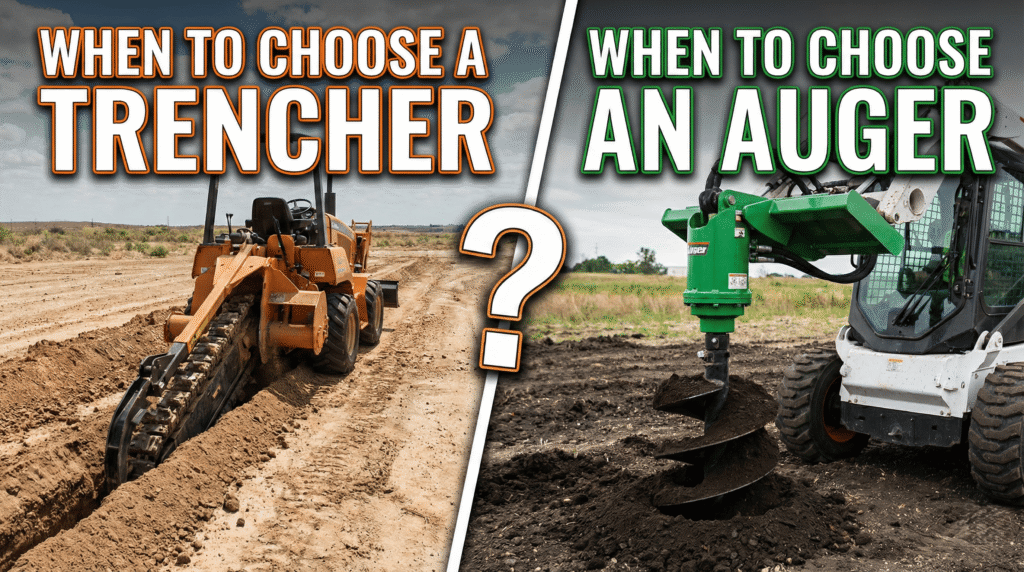
When to Choose an Auger for Your Project
The auger is the clear winner for any project that requires structural uprights. If you are building a fence, the thought of digging fifty holes with a manual post-hole digger is daunting. A skid steer auger can drill those same fifty holes in a fraction of the time with significantly less physical strain. It ensures that every hole is perfectly vertical, which is essential for the integrity of a fence or a deck.
Besides construction, augers have been an integral part of agriculture and landscaping for years. The chore of planting a row of privacy trees is less taxing when you can drill a perfect hole for the root ball in seconds. For owners of the TYPHON STOMP series, an auger will deliver sufficient torque allowing the tool to be effective against frozen soil or heavy clay thus turning it into a consistent, all-season accessory.
- Post-Hole Digging: Is various fences, signs, and light spot. The standard tool used in the industry.
- Foundation Footings: Piers and deck supports are quickly set by holes drilled for concrete.
- Tree & Shrub Planting: Makes hole sizes uniform for better root development.
Maintenance Tips for Your Skid Steer Attachment
Maintaining the Trencher vs. Auger comparison at the productivity level means that you have to keep your tools in good condition. (R) trenchers are especially dependent on the chain Tension; a slack one will slip or break, while an overly tight one will increase wear on the motor. Teeth are the cutting essentials of the equipment, hence, you should check them often and change them accordingly to avoid exhaustion of the machine’s power.
On the flip side, caution for the auger should be considered mainly for the hydraulic motor and the parts of the drill bit such as the ‘tooth’ at the bottom of the bit and the ‘pilot’ (point or tip), which are naturally made replaceable.
Once the aforementioned parts get worn or blunt, the auger bit’s penetration power through the ground will decrease resulting in the generation of excessive heat and potential failure of the hydraulic system. Prior to the use of your TYPHON Mini Skid Steer, a leak test of the hydraulic connections should be conducted.
- Chain Tension: Make sure to check the trencher chain frequently during the operation for wear and adjust as needed.
- Lubrication: All grease level points need to be sufficiently oiled to prevent the rise of friction-related issues.
- Teeth Inspection: To uphold cutting efficiency and fuel economy, changing blades of the biting tool should be done in a timely manner.
Frequently Asked Questions – Skid steer attachment Trencher vs. Auger
Can I use an auger to dig a trench?
While technically, you could drill a series of holes side by side and then shovel out the material in between, this manner of working is highly inefficient. Augers are meant to make vertical holes, and trenchers are made for continuous linear paths.
How deep can a skid steer trencher go?
Standard trenching attachments for skid steer loaders can normally extend trenches anywhere between 3 and 4 feet. However, this depth is largely dependent on the size of the boom which comes with the trencher attachment.
What size auger bit do I need for a 4×4 fence post?
It is generally a good idea to go for an 8 or 10-inch auger bit for a 4×4 post. This bit size will provide ample space for concrete or compacted gravel to solidify the structure.
Can a trencher cut through rock?
Regular dirt teeth can handle a break even rock. Where you are in rocky country if you are going to need a “rock chain” or “alligator chain” with your “rock teeth”. ” You will need the stronger kind of carbide-tipped teeth seen in the chains designed for rock cutting to get the job done right.”
How much hydraulic flow does an auger need?
The hydraulic specifications of different models vary, but most TYPHON STOMP mini skid steer models offer sufficient “Standard Flow” (approx. 10-15 GPM) to efficiently run a typical 12-inch auger.
Is it better to buy or rent these attachments?
If you are only doing a one-off project such as a fence, then asking for rental of the equipment is a cheap way to get it done. On the other hand, contractors or farmers buying a piece of TYPHON machinery equipment should pick up an attachment for long-term savings and availability of equipment.
Which attachment is safer to operate?
Both save if used as per the operator’s manual. The trencher being reversed means one should be extra aware of the surroundings. While using an auger, the operator should never stand near the bit that is being rotated.
Conclusion: Making the Right Investment
When discussing the Trencher vs. Auger topic, there isn’t a better one among the two i.e. it just depends on the job. Laying down cable lines or setting an irrigation system would be your best buddies if you pick a trencher. On the other hand, your auger will be a great asset if you’ll be erecting fences, building structures, or planting trees.
We at SteerSkid.com have TYPHON STOMP Mini Skid Steer loaders which are well optimized for both of these strong tools. By pairing your equipment with a suitable attachment, you not only get maximum output but also less labor and your first-rate job will become your trademark. Come and shop our inventory now for the attachments that will uplift your enterprise or project to the next level.