
Box Blade vs Skid Steer Soil Conditioner: Understanding the Key Application Differences for Optimal Job Site Grading
When you roll up to a fresh, chaotic job site that is covered in rutted dirt, scattered rocks, and violently uneven terrain, picking the exact right skid steer attachment is often the ultimate deciding factor between running a profitable day and burning expensive diesel fuel for nothing. Two of the most highly discussed, frequently compared, and absolutely essential tools in the commercial landscaping and heavy grading arsenal are the traditional box blade and the powered skid steer soil conditioner.
While a novice equipment operator might look at both of these heavy-duty attachments and assume they fundamentally perform the exact same job—moving loose dirt around to make the ground look flat—veteran earthmovers and landscaping professionals know that their real-world applications are actually night and day.
You certainly wouldn’t use a heavy sledgehammer to drive a delicate finishing nail, and you similarly should never use a highly sensitive soil conditioner to carve out a massive, deep drainage swale.
Best Skid Steer Soil Conditioners and Power Rakes for Seedbed Prep
Understanding the precise mechanical differences, the specific soil interaction dynamics, and the ideal staging order for these two distinct implements is absolutely critical for anyone operating a skid steer loader for commercial site prep, agricultural land leveling, or high-end residential hardscaping.
Let’s break down exactly how these two powerhouse attachments operate in the dirt so you can stop guessing and start grading your projects with maximum efficiency.
- Selecting the correct grading attachment drastically reduces unnecessary machine wear and prevents expensive downtime caused by utilizing the wrong tool for the job.
- Understanding the mechanical limits of each implement allows equipment operators to bid on complex site preparation jobs with much higher accuracy and confidence.
- Properly sequencing a box blade and a soil conditioner on the same job site yields a perfectly finished, professional grade that manual labor simply cannot replicate.
The Heavy-Duty Core Function of a Skid Steer Box Blade
The classic skid steer box blade is widely considered the undisputed heavyweight champion of aggressive bulk earthmoving, heavy material relocation, and foundational rough grading operations. You can accurately think of a box blade as a miniature bulldozer blade seamlessly combined with a heavy-duty agricultural ripping tool, encased in a rigid steel box that actively traps and drags massive volumes of material.
When a contractor needs to drastically alter the fundamental topographical layout of a property, the box blade is always the very first attachment to hit the dirt, aggressively cutting down elevated high spots and dragging that heavy, packed soil to fill in deep, problematic depressions.
Furthermore, most commercial-grade box blades are equipped with a highly aggressive row of drop-down steel scarifier shanks, which are specifically engineered to violently tear up baked summer clay, rip through heavily compacted gravel driveways, and completely shatter stubborn hardpan layers.
Because a box blade has absolutely no moving mechanical parts or complex hydraulic motors, it relies entirely on the brute pushing power and heavy traction of the skid steer itself to physically force the cutting edge through the earth.
- Excels at highly aggressive cut-and-fill operations, easily dragging massive piles of heavy dirt from high elevations to fill in deep holes across a vast job site.
- Features heavy-duty, adjustable steel scarifier shanks that can be strategically dropped down to violently rip up baked clay, gravel, or stubborn, unyielding hardpan.
- Acts as the perfect, indestructible initial response tool for completely reshaping the topographic contour of a property long before any fine finishing work begins.
The Ultimate Precision of a Powered Skid Steer Soil Conditioner
In stark contrast to the sheer brute force of a box blade, a skid steer soil conditioner operates as a highly refined, hydraulically powered precision instrument explicitly designed for final seedbed preparation and delicate surface texturing.
Instead of merely dragging heavy dirt from one location to another, a soil conditioner utilizes a rapidly spinning, horizontally mounted drum covered in aggressive carbide-tipped teeth to physically chew up the top layer of the ground.
This high-speed rotary action systematically pulverizes hard, compacted dirt clods into a wonderfully fine, deeply aerated, and perfectly sifted soil profile that is incredibly receptive to delicate grass seed, expensive sod rolls, or agricultural planting.
As the heavy drum spins, it also expertly separates destructive surface rocks, tangled tree roots, and leftover construction debris, cleanly windrowing all the unwanted trash to the side of the machine’s operational path for easy disposal.
Most modern soil conditioners also feature a highly sophisticated floating linkage system that allows the heavy attachment to gracefully follow the natural, undulating contour of the ground, smoothing out minor surface imperfections without accidentally digging massive gouges into the previously established rough grade.
- Utilizes a rapidly spinning, carbide-tipped rotor to aggressively pulverize hard dirt clods into a fine, thoroughly aerated, and perfectly sifted planting surface.
- Expertly separates destructive surface rocks, entangled roots, and hazardous construction debris by windrowing them cleanly to the side of the operator’s path.
- Maintains a highly delicate, self-leveling floating action that perfectly smooths out minor terrain imperfections without entirely altering the established foundational grade.
Head-to-Head Application Differences in the Field
When you put a box blade and a skid steer soil conditioner head-to-head on an active, messy job site, the distinct operational boundaries between bulk material moving and fine surface finishing become incredibly obvious.
If you pull up to a site where a demolition crew has just left, leaving behind massive mounds of dirt, deep tire ruts from heavy excavators, and a completely destroyed slope, you absolutely must start with the box blade to establish a workable, flat baseline. However, once that rough contour is finally established, the box blade has reached the absolute limit of its usefulness for landscaping purposes, as it tends to leave the soil highly compacted, smeared, and full of fist-sized dirt clods that will severely hinder root growth.
This is exactly where you drop the box blade and hook up the powered soil conditioner, utilizing its spinning drum to lightly mill the top two to three inches of the freshly graded dirt, fluffing the soil, removing the leftover rocks, and creating a pristine, golf-course-quality finish.
Attempting to skip the box blade phase and use a soil conditioner to move massive dirt mounds will inevitably stall out the machine’s hydraulics, severely overheat the skid steer, and likely cause catastrophic premature failure of the attachment’s internal rotor bearings.
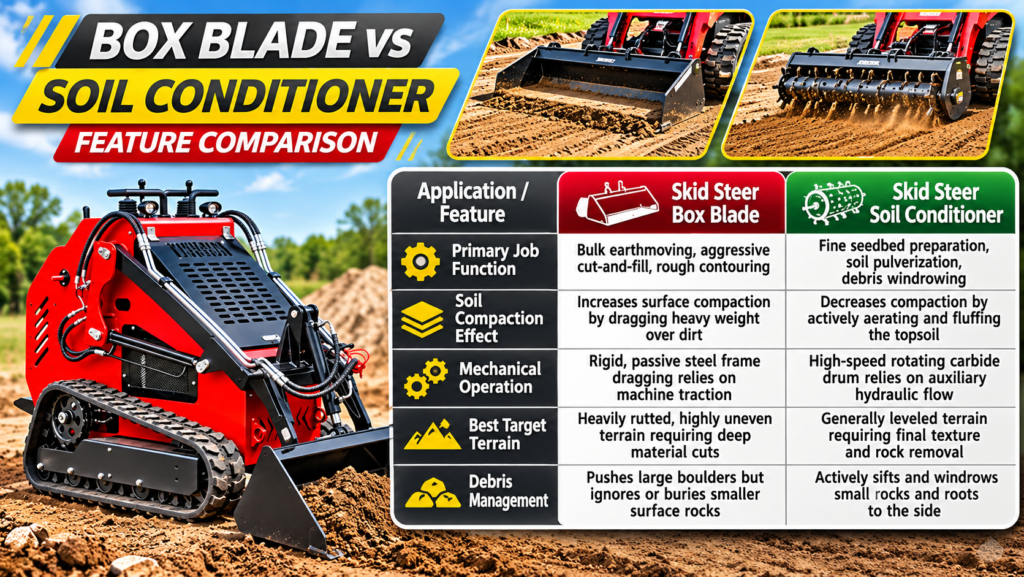
Table: Box blade vs skid steer soil conditioner Features
| Application / Feature | Skid Steer Box Blade | Skid Steer Soil Conditioner |
| Primary Job Function | Bulk earthmoving, aggressive cut-and-fill, rough contouring | Fine seedbed preparation, soil pulverization, debris windrowing |
| Soil Compaction Effect | Increases surface compaction by dragging heavy weight over dirt | Decreases compaction by actively aerating and fluffing the topsoil |
| Mechanical Operation | Rigid, passive steel frame dragging relies on machine traction | High-speed rotating carbide drum relies on auxiliary hydraulic flow |
| Best Target Terrain | Heavily rutted, highly uneven terrain requiring deep material cuts | Generally leveled terrain requiring final texture and rock removal |
| Debris Management | Pushes large boulders but ignores or buries smaller surface rocks | Actively sifts and windrows small rocks and roots to the side |
- Box blades fundamentally move huge, heavy volumes of raw material, while soil conditioners refine, texturize, and aerate the material that is already in place.
- The operational speed of a heavy box blade is strictly dictated by ground traction, whereas a conditioner relies heavily on the skid steer’s high-flow hydraulic output.
- A professional job site often requires both tools in strict sequence: the box blade establishes the rough contour, and the conditioner follows up to create the seedbed.
Selecting the Right Tool for Your Specific Project
Determining which skid steer attachment perfectly aligns with your daily operational needs requires a deep, honest assessment of the specific types of contracts your business typically handles.
If your company primarily focuses on heavy hardscaping, installing expansive concrete driveways, pouring commercial foundation pads, or building large retaining walls, the box blade is undeniably your go-to attachment for quickly creating a densely compacted, highly stable, and perfectly flat sub-base.
Conversely, if your crew specializes in high-end residential landscaping, vast commercial lawn installations, sports field turf maintenance, or large-scale hydroseeding projects, a high-quality soil conditioner is strictly mandatory for ensuring consistent, healthy root success and rapid seed germination.
Interestingly, contractors tasked with reclaiming old, overgrown gravel parking lots or tearing out long, abandoned dirt driveways will typically rely on the aggressive ripping teeth of a box blade to break the initial crust, rather than risking expensive damage to the spinning drum of a delicate conditioner.
Budget constraints also play a major role in fleet management; a heavy-duty box blade is generally a much lower initial capital investment with virtually zero hydraulic maintenance, making it a highly accessible staple, whereas a soil conditioner requires a significantly higher upfront cost but pays for itself incredibly fast by totally eliminating the need for a massive crew of laborers hand-raking rocks all day.
- Concrete and foundation contractors rely heavily on the box blade to establish incredibly dense, highly compacted, and perfectly flat sub-grade surfaces.
- Turf and landscaping professionals absolutely depend on the soil conditioner to create the fluffy, aerated tilth required for fragile seed germination.
- Evaluating your company’s primary service offerings prevents you from wasting massive amounts of capital on an expensive hydraulic tool you rarely need to deploy.
Pro Tips for Heavy Machinery Operators
Maximizing the daily efficiency and extending the long-term lifespan of both your box blade and your soil conditioner requires strict adherence to proper, safe operational techniques and actively avoiding the most common rookie mistakes on the job site.
When running a soil conditioner, professional operators always utilize a highly specific cross-hatching pattern—running passes in one direction and then immediately crossing over them perpendicularly—to completely eliminate directional ridges, erase wheel tracks, and create a flawlessly uniform, totally flat surface.
When operating a standard box blade, you must always remember to physically retract or flip up the heavy steel scarifier teeth during your final, delicate smoothing passes; otherwise, you will accidentally tear deep, highly frustrating trenches into the perfectly leveled grade you just spent an hour creating.
Furthermore, operators must constantly and meticulously inspect the carbide-tipped teeth on their soil conditioner’s rotor, as well as the reversible, bolt-on steel cutting edges of their box blade, to ensure they are not wasting expensive diesel fuel trying to force hopelessly dull metal through baked, rock-hard earth.
Finally, never attempt to operate a soil conditioner in extremely wet, muddy conditions, as the spinning drum will simply smear the wet clay into impenetrable, heavy clumps rather than breaking it down into a usable, highly refined planting medium.
- Always utilize a perpendicular cross-hatching pattern when running a soil conditioner to completely eliminate directional machine tracks and terrain ridges.
- Never forget to physically retract a box blade’s scarifier teeth during final smoothing to avoid carving deep, unwanted gouges into the finished grade.
- Consistently inspect all cutting edges and carbide teeth for excessive wear to maintain high operational speed and significantly reduce overall fuel consumption.
FAQs – Box blade vs skid steer soil conditioner
Can a box blade easily remove rocks from the soil?
A box blade can successfully push massive, heavy boulders out of the way, but it is terrible at filtering out smaller rocks. It typically ends up burying small rocks or dragging them along, which is why a soil conditioner is required for actual rock separation and clean windrowing.
Is a skid steer soil conditioner better than a tiller?
Yes, for commercial applications, a soil conditioner is vastly superior to a standard tiller because a conditioner operates in reverse rotation to actively kick rocks out of the soil profile, whereas a traditional tiller simply buries rocks deeper into the ground.
Do I really need high-flow hydraulics for a soil conditioner?
While standard-flow soil conditioners certainly exist and perform decently well on smaller machines, utilizing a high-flow skid steer model provides significantly more rotational torque to the drum, preventing the attachment from stalling out in heavy, wet clay or highly compacted dirt.
How deep can a standard box blade actually dig?
When the heavy steel scarifier shanks are fully deployed and dropped to their lowest setting, a commercial-grade box blade can typically rip up to 4 to 6 inches deep into highly compacted hardpan or dense gravel surfaces.
Why is my soil conditioner leaving thick ridges on the edges?
This commonly occurs when the operator is driving the skid steer entirely too fast for the hydraulic flow, or the side plates of the conditioner are adjusted improperly. Slowing the machine’s ground speed down to 1 to 2 mph usually completely resolves the heavy ridging issue.
Can I use a box blade to remove heavy brush and tall weeds?
A box blade can easily scrape away light, shallow-rooted surface vegetation, but it will quickly become hopelessly clogged if you attempt to push through thick, established brush. A heavy-duty forestry mulcher or a specialized brush cutter is heavily recommended for land clearing.
Does a box blade work well going backwards?
Yes, most high-quality, commercial box blades are specifically designed with a hinged, rear-facing tailgate or a secondary rear cutting edge, allowing the operator to smoothly back-drag the heavy attachment to cleanly flatten out excess dirt piles and achieve a smoother final finish.