
What Every Operator Should Know About Skid Steer Safety Components
Skid steer operation is a difficult task that need great coordination, skill, and mostly a strict dedication to safety in all circumstances. These heavy machineries are extremely useful due to their compactness and force but they can be pretty dangerous if not used properly which emerges the prominence of the skid steer safety components in every operators day-to-day work life.
Let us have a look at the best skid steer safety kit to improve the knowledge of every operator.
Operators Mandatory List on Skid Steer Safety Components
Today’s skid steers have some very smart safety gadgets that can prevent the operator and others around the machine from serious accidents such as rolling over, getting crushed, etc. Knowing the skid steer safety components is just the beginning if you want to keep your operation accident-free.
This blog is a roadmap to the major components that top operators must have at their fingertips. We not only touch on the durability of the cabin but also on sophisticated interlock systems because understanding how these features work will enable you to balance efficiency and safety.
The Backbone of Safety: ROPS and FOPS
The operator’s cab is usually the most defining and key skid steer safety components. Actually, it is not only a work place but a life chamber capable of withstanding very harsh situations.
- ROPS (Roll-Over Protective Structure): This strong structure is made to preserve the operator’s life in case of a roll over by shielding the cabin from being crushed under the machine’s weight.
- FOPS (Falling Object Protective Structure): This type of protection acts like a cover from heavy objects -such as rocks, debris, or even palletized loads – falling from heights onto the top of the machine.
- Structural Integrity: Operators must closely and constantly check these structures for the presence of cracks, rust, or signs of old repairs. A minor hole or weld left unchecked might be enough to jeopardize the cabin’s structural certification.
Table: Skid Steer Safety Components Maintenance Requirements
| Component | Primary Function | Maintenance Requirement |
| ROPS | Protects during rollovers | Visual check for cracks/bends |
| FOPS | Shields from falling debris | Ensure roof bolts are tight |
| Side Screens | Keeps limbs inside the cab | Check for mesh tears/damage |
The Operator Restraint System: More than a Belt
The restraint system of a skid steer is a safety net, a multi-layered one. It is meant to hold you firmly in your safe seat, away from the moving lift arms and other pinch points.
- Safety Belt: It is like the seatbelt of a car. In a sudden stop or tip-over, the belt stops you from getting thrown against the steering wheel or getting ejected from the cab.
- Seat Bar (Restraint Bar): Acts as mechanical lock for the hydraulic system and also a secondary restraint. When the bar is up, the machine will most probably not move. Sometimes the bar is also electrically connected with the machine control system.
- Interlock Systems: Today’s machines are equipped with “Operator Presence” sensors. When the seatbelt is not fastened or the seat bar is raised, the engine may be turned off or the hydraulic controls will get locked automatically to avoid unintentional activation.
Lift Arm Support Devices
This is one of the situations that has lead to a great number of fatalities through crushing when the lift arms are raised but no support is used.
- Mechanical Pins: Skid steer trucks normally have a lift arm support device built-in that is often a pin or a strut and must be engaged whenever the arms are raised for service.
- Hydraulic Lockouts: These valves stop the hydraulic fluid from bypassing the cylinders, thereby “holding” the arms in place independently of whether a hose fails.
- Operator Vigilance: If you have left your cab, never depend on the machine’s hydraulic pressure to hold the arms up. Always use the physical support device.
Essential Communication: Lights, Alarms, and Decals
The physical barriers of safety components are not the only ways of protection; they also serve as communication tools of the machine to the outside world.
- Backup Alarms: Skid steers have significant blind spots to the rear. Therefore, ground crew must be alerted about your movements through a sound backup alarm which is always set to functional mode; no exceptions.
- Warning Decals: These stickers are stuck at “pinch points” and “crush zones.” They give instant visual prompts about the risks linked with different parts of the machine.
- Strobe and Work Lights: Visibility is a two-way street. You need powerful LED work lights to detect things you might trip over, but also strobe lights are necessary for other operators of the equipment to notice you during low light or dust conditions.
The Hydraulic System and Emergency Exits
The powerful force of a skid steer safety components is unleashed using high-pressure hydraulics but this force can be very dangerous especially when components are ignored.
- Pressure Relief Valves: These constituents assure that the system does not exceed its rated capacity, thereby protecting hoses from bursting under heavy loads.
- Emergency Exit (Rear Window): In case the front door is blocked by the lift arms or jammed, the operator should be familiar with the emergency exit, which is generally the rear window.
- Hydraulic Couplers: Check that the attachments are properly locked. Attachments that are not secured adequately may come loose to cause tip-over hazard or injure a person who is nearby.
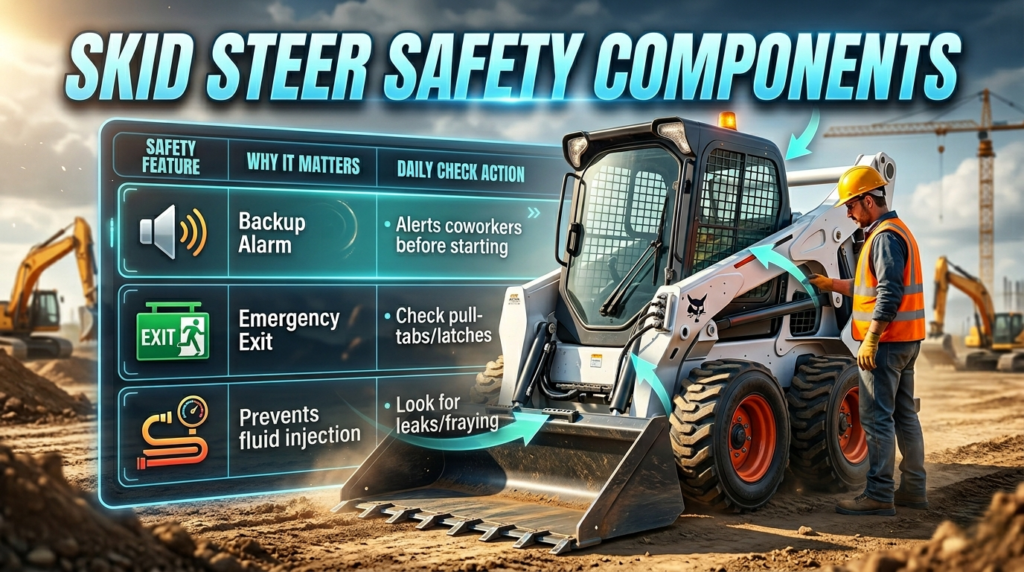
Table: Skid Steer Safety Components
| Safety Feature | Why It Matters | Daily Check Action |
| Backup Alarm | Alerts coworkers | Test in reverse before starting |
| Emergency Exit | Path to safety if trapped | Check pull-tabs/latches |
| Hydraulic Hoses | Prevents fluid injection | Look for leaks/fraying |
Pre-Operation Inspection Checklist
Before you even start the engine, a thorough walk-around that is the most effective way to make sure that your skid steer safety components are all set for the shift.
- Check Fluids: Hydraulic and engine oil running low can be a cause of mechanical break-down that may happen unexpectedly, leading to loss of control of the machine.
- Inspect Tires/Tracks: Check tire pressure and evenness of the tracks tension. Lack of traction is one of the main reasons why machines become unstable when working on slopes.
- Test Controls: After you get in, move joysticks and pedals around to feel if the controls respond accordingly. Any “stickiness” or hesitation in the hydraulics should be reported right away.
Safe Entry and Exit Procedures
It may sound odd, but in fact, a great number of accidents happen while the skid steer is not moving. The entry and exit procedures from the cab also require operator awareness of the safety components.
- Three-Point Contact: This means (two hands/one foot or one hand/two feet) that you always need to have three points of contact with grab handles and steps.
- Clean Steps: If you want to avoid slipping and falling that might cause you to hit control levers incidentally, you better ensure that the entry steps have no mud, ice, or oil.
- Face the Machine: This is the safest way when entering or exiting. You should always face the cab. Never jump off the machine as it is a common cause for bruises to knees and ankles.
Frequently Asked Questions (FAQ) – Skid Steer Safety Components
Do I need a special license to operate a skid steer?
Unless it is a totally new state mandated requirement to get a “skid steer license” for private use, most states do not issue such licenses. However as far as OSHA is concerned employees should be properly trained and evaluated by the employer before they can legally operate the machine on a job site.
What is the “Rated Operating Capacity” (ROC), and why is it a safety component?
ROC defines the maximum weight that a skid steer can safely lift without losing stability. In fact, the major cause of the tip-overs has been the over loading. On that basis it is a safety parameter required of all operators.
Why is it called a “Skid Steer”?
That name comes from the turning style. The wheels or tracks on each side operate independently. When you want to turn, the side that is turning moves faster or even in the opposite direction, which causes the tires to skid across the ground while changing direction.
Can I bypass the seat bar sensor if it’s malfunctioning?
You cannot do that at all. Turning off or removing any skid steer safety components such as the seat bar or the seatbelt sensor is prohibited as per safety rules and it will drastically increase your risk of getting killed in case of a crushing accident.
What should I do if a hydraulic hose starts leaking?
Immediately stop work and put lift arms down while shutting off the engine. Apart from that, stay away from the leak and don’t use your hands to check for fluid because that high pressure fluid can penetrate your skin causing serious injuries that will require urgent medical attention.
Is it safe to carry a passenger in the cab or the bucket?
No. Skid steers are designed for “one seat, one operator.” Carrying passengers either in the cab or in the bucket is extremely dangerous and is a major cause of fatalities due to falling and crushing.
How do I use the emergency exit on a skid steer?
Usually, the rear window is the emergency exit on most models. To get out when the front exit is blocked, there is mainly a pull-tag or a handle by which the glass can be removed or the entire window frame can be taken out for climbing.