
Skid Steer Snow Pusher vs Blade vs Blower: The Ultimate Winter Setup
Let’s face it, when that first major winter storm hits, managing property access goes from a minor headache to a massive, time-sensitive operation almost overnight. Whether you are a seasoned contractor handling commercial lots or a property owner just trying to keep a long farm lane open, having the right iron for the job isn’t a luxury—it’s survival. Let’s learn the skid steer skid steer snow removal attachments and understand the skid steer snow pusher vs blade vs blower.
Your skid steer is probably already the most versatile machine in your fleet, but its real value shines when temperatures drop and the white stuff starts piling up. The secret to turning a freezing, miserable chore into a profitable and fast operation all comes down to picking the right tools.
Trying to clear a massive lot with the wrong attachment is a great way to waste fuel, burn out your operators, and completely wreck your bottom line. Understanding the real-world differences between various skid steer snow removal attachments is how you win the winter season.
A reliable machine, like the rugged TYPHON Mini Skid Steer Loader from SteerSkid, paired with the perfect winter tool will cut your clearing time in half and save your loader from unnecessary wear and tear.
Before you pull the trigger on a new piece of winter gear, you really need to sit down and figure out a few things about your operation:
- Take a hard look at your actual terrain: Are you dealing with wide-open commercial asphalt, tight residential sidewalks, or long, winding gravel driveways that easily get chewed up?
- Know your loader’s true specs: Don’t just guess; double-check your machine’s auxiliary hydraulic flow (GPM), operating capacity, and weight so you don’t buy an attachment your rig can’t handle.
- Think about what you can’t see: Snow covers everything. You want attachments with built-in trip edges to save your machine from getting wrecked by hidden curbs or raised manhole covers.
The Raw Pushing Power of the Skid Steer Snow Pusher
If you spend your winters staring down massive commercial parking lots, airport tarmacs, or huge logistics yards, the skid steer snow pusher is going to be your best friend. A lot of guys call these things snow boxes or containment plows because that’s exactly what they do—they box the snow in.
Built with heavy-duty side plates, a pusher is designed to grab a massive volume of snow and push it straight ahead without letting it spill out the sides. When you are trying to clear a sprawling five-acre lot, you don’t want snow trailing off the edges of your blade and forcing you to make three extra cleanup passes.
With a pusher, you just drop the boom, hit the gas, and ride that wave of snow all the way to the outer edge of the property. Because they trap the snow so effectively, they are widely considered one of the fastest skid steer snow removal attachments for big, flat, open spaces.
Mechanically speaking, skid steer snow pusher are beautifully simple, which is exactly what you want when it’s five degrees outside and the wind is howling. Fewer moving parts mean there is way less that can break down in the middle of a midnight blizzard shift.
A lot of the newer models come with floating cutting edges that independently ride the contours of the pavement, meaning you scrape down to the blacktop without damaging the surface or rattling your teeth out in the cab.
When you are looking into adding a snow box to your winter fleet, keep these practical points in mind:
- It’s all about maximum containment: Those big side panels trap the snow, letting you push a mountain of it in a single, straight forward pass.
- Built for the long haul: These are the undisputed kings of moving snow from the absolute center of a property straight to the far edges where you can pile it sky-high.
- You lose your directional control: The major downside is that you can’t angle a pusher. If you need to push snow off to the side while driving down a long road, this isn’t the tool for you.
Getting Precise with the Skid Steer Snow Blade
Sometimes you don’t need brute force; you need finesse and speed. When your route sheet is packed with long access roads, winding suburban driveways, or tight agricultural lanes, the angled snow blade is the tool you want hooked up to your loader. Instead of trapping the snow like a box, a snow blade uses a curved moldboard to catch the snow and continuously roll it off to the side as you drive forward.
This creates those nice, neat windrows you see along the side of plowed streets. What makes modern hydraulic snow blades so incredible is that you can adjust the angle of the blade left or right without ever leaving the heated cab.
That kind of on-the-fly adjustability makes it one of the most flexible skid steer snow removal attachments out there, especially when you are trying to navigate around parked cars or intricate landscaping without burying them.
The actual shape of the blade matters a lot more than people think. A taller blade with a deep curve is going to hold way more snow and keep it rolling rather than letting it blow back over the top onto your windshield. Plus, if you are plowing anywhere near concrete, a trip-edge mechanism is basically mandatory.
When you inevitably hit a frozen curb or a chunk of ice you didn’t see, the bottom edge of the blade tips backward to absorb the shock, and then snaps right back into place. That simple feature will save your loader arms from bending and keep your operator from getting whiplash.
Here is why a lot of professionals refuse to plow without a good angle blade:
- Total control over where the snow goes: The hydraulic angling lets you steer the snow away from buildings and sidewalks while keeping your forward momentum going.
- Perfect for high-speed clearing: Because the blade rolls the snow off the side, you can travel much faster down long driveways or unbroken stretches of pavement.
- It isn’t just a winter tool: A lot of guys lock the blade straight and use it in the summer for light grading work, spreading topsoil, or leveling gravel driveways.
Handling Deep Drifts with the Snow Blower
We’ve all been there—you plow a property for three days straight, and suddenly, you have literally nowhere left to put the snow. The piles are too high, the lot is too tight, and another foot just dropped.
That is exactly when you need to bring in a skid steer snow blower. Unlike blades and pushers that just shove the snow around, a blower actively eats it. It uses a heavy-duty auger to chew through deep, packed snow, feeds it into a spinning impeller, and blasts it out a chute up to forty feet away.
If you are dealing with tight urban sidewalks, narrow residential properties bordered by expensive fences, or areas that get buried in heavy blizzards, the blower is the only way to get the job done right. It doesn’t leave towering snowbanks at the edges of the driveway; it just throws the problem entirely out of the way.
Now, running a blower isn’t quite as simple as just hooking it up and driving. These things are incredibly hungry for hydraulic power. You aren’t relying on the weight of the loader to push the snow; you are relying on the hydraulic flow (GPM) to spin the auger and the fan.
You really have to make sure your machine has the guts to run a commercial blower, or you’re just going to bog down in heavy, wet slush. While you won’t clear a parking lot as fast as you would with a skid steer snow pusher, you will leave behind an insanely clean surface without losing any parking spaces to snow piles.
If you are thinking about stepping up to a blower this winter, remember how they operate:
- You completely relocate the snow: Instead of just piling it up on the property, you can blast it over fences, off the edge of the lot, or even right into the back of a dump truck.
- They are lifesavers in tight spaces: When walls, landscaping, or property lines mean you have zero room for snow piles, a blower is basically your only option.
- They demand serious hydraulics: You absolutely must match the blower’s requirements to your skid steer’s hydraulic output, otherwise the attachment won’t have the torque to chew through wet snow.
Direct Comparison: Skid Steer Snow Pusher vs. Blade vs. Blower
Figuring out exactly which attachment to buy really comes down to looking at your route sheet and knowing your machine. Because skid steer snow removal attachments aren’t cheap, making the wrong call can hurt your wallet. Honestly, a lot of the pros out there use a mix. Because machines like the TYPHON Mini Skid Steer use a universal quick-attach system, a lot of guys will keep a skid steer snow pusher on the trailer for the big open lots and quickly swap to a blower when they hit the tight sidewalks.
Take a look at this breakdown to see how they stack up against each other in the real world:
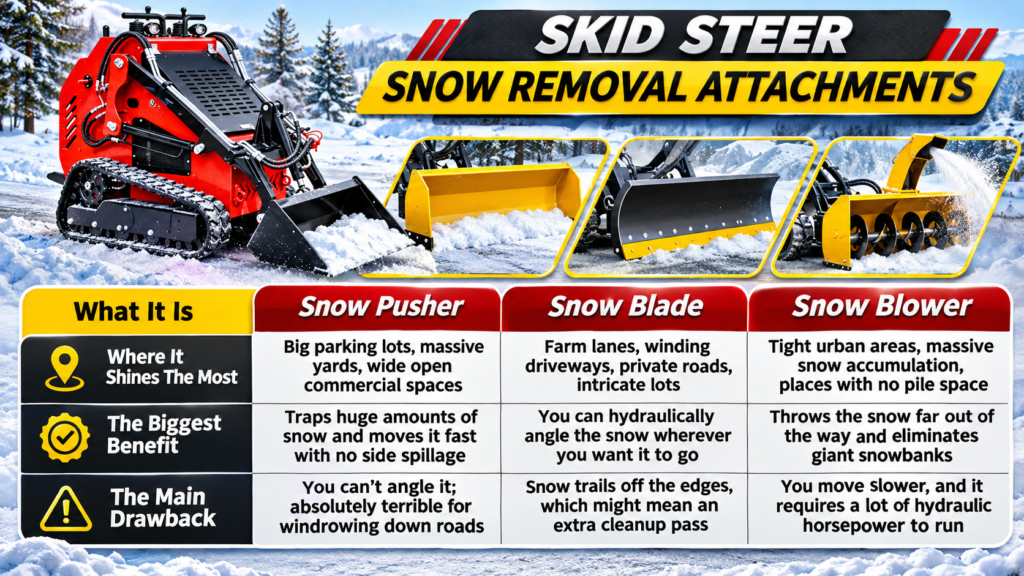
Table: Skid Steer Snow Removal Attachments: Skid Steer Snow Pusher vs. Blade vs. Blower
| What It Is | Where It Shines The Most | The Biggest Benefit | The Main Drawback |
| Snow Pusher | Big parking lots, massive yards, wide open commercial spaces | Traps huge amounts of snow and moves it fast with no side spillage | You can’t angle it; absolutely terrible for windrowing down roads |
| Snow Blade | Farm lanes, winding driveways, private roads, intricate lots | You can hydraulically angle the snow wherever you want it to go | Snow trails off the edges, which might mean an extra cleanup pass |
| Snow Blower | Tight urban areas, massive snow accumulation, places with no pile space | Throws the snow far out of the way and eliminates giant snowbanks | You move slower, and it requires a lot of hydraulic horsepower to run |
When you are ready to pull the trigger and add to your winter arsenal, keep this advice in mind:
- Buy for the bulk of your work: If 90% of your route is long residential driveways, don’t buy a massive pusher. Get a high-quality angle blade first.
- Size matters a lot: If you are running a compact rig like the TYPHON STOMP 1800lbs, make sure you get attachments sized appropriately so you don’t overwork the loader.
- Look into hybrid options: If you have the budget, look at V-blades or hydraulic snow wings that give you the boxing power of a pusher with the angling of a blade.
Why Guys Trust SteerSkid for Winter Iron
When the snow starts falling, you cannot afford to have your equipment fail. It’s that simple. SteerSkid.com has built a solid reputation in the United States as a trusted supplier of heavy machinery because they understand that contractors and property owners need stuff that actually works when conditions get rough.
If you are looking to upgrade your fleet before the snow flies, the TYPHON Mini Skid Steer Loaders they carry are absolute beasts. The TYPHON STOMP series packs incredibly reliable Kubota and B&S gas or diesel engines into a compact frame that can fit almost anywhere. They deliver the hydraulic punch you need to run serious skid steer snow removal attachments without the massive footprint of a full-sized loader.
But it isn’t just about the iron; it’s about how they treat you after you buy. SteerSkid runs a massive warehouse right in Commerce, California. That means you aren’t waiting three months for a machine to float across the ocean while your lot gets buried in snow. They get you what you need, when you need it, and they stand behind it.
Here is why a lot of guys are making the switch to SteerSkid:
- Insanely fast U.S. shipping: They guarantee a 14-day delivery straight from their California warehouse to your shop, so you are ready before the weather turns.
- Real, 24/7 technical support: If you blow a line or have a mechanical issue in the middle of a midnight shift, their team is actually there to help you troubleshoot it.
- Small footprint, big power: These compact loaders can lift over 830 pounds and are built rugged enough to handle the absolute worst winter conditions without missing a beat.
FAQs – Skid Steer Snow Pusher vs Blade vs Blower
What size snow blade should I actually buy for my skid steer?
The golden rule is that your blade needs to be wider than your machine’s tires or tracks even when it is fully angled. If your skid steer is 72 inches wide, you generally want an 84-inch blade. That way, when you angle it at 30 degrees, your tires are still driving on the pavement you just cleared, rather than packing down the snow you missed.
Should I go with a snow blade or a snow box for my loader?
Look at your route sheet. If you are clearing massive, flat commercial parking lots where you just need to shove huge piles of snow straight into a corner, buy the snow box (pusher). If you clear long roads, driveways, or tight lots where you need to steer the snow to the sides, you need the snow blade.
Do I really need auxiliary hydraulics for a skid steer snow blade?
If you want to be efficient, yes. A hydraulic angle blade uses your machine’s auxiliary lines to pivot left or right from inside the cab. You can buy manual angle blades to save money, but you will have to get out of the warm cab into the freezing cold every time you want to change the angle, which gets old real fast.
Can I use my snow blade for dirt work in the summer?
You absolutely can, as long as it’s a heavy-duty model. A lot of good snow blades let you lock out the trip springs so the blade stays rigid. Once it’s locked, it works great for backfilling small trenches, spreading loose topsoil, or leveling out gravel driveways when the snow melts.
How is a snow blower different from a Skid Steer Snow Pusher?
A skid steer snow pusher is basically a big steel box that traps snow and shoves it forward across the ground. It relies on the traction of your tires. A snow blower is a complex hydraulic machine that grinds up the snow and physically throws it through the air out of a chute. You use a blower when you have literally no ground space left to pile snow.
How do I get my skid steer ready for winter plowing?
Don’t wait for the first storm. Check all your hydraulic hoses because cold weather makes rubber brittle. Grease every single pivot point, make sure your battery has strong cranking amps for cold mornings, and switch over to winter-weight engine oil and hydraulic fluid so your machine doesn’t hate you when you start it at 3 AM.
What is the absolute best attachment for a huge parking lot?
Without a doubt, it’s the skid steer snow pusher. Because it has enclosed sides, the snow doesn’t spill out into windrows. You can capture a massive volume of snow and run it all the way across a giant commercial lot in one straight shot, which cuts your time on the property way down.