
Compact Utility Loader: The Contractor’s Guide to Maximum Productivity
If you’ve spent any time working in construction, landscaping, or hardscaping lately, you already know the drill. The physical toll of the job is brutal, and finding reliable hands to push a wheelbarrow all day is getting harder every single year. Let’s be honest, the days of throwing raw manpower at a backyard grading project are pretty much over. You need a smarter way to move dirt without wrecking your back or destroying your client’s pristine lawn. Enter the compact utility loader guide (often called a mini skid steer).
These bite-sized powerhouses have completely changed the way modern crews tackle tight-access jobs. They pack an unbelievable amount of hydraulic punch into a frame small enough to squeeze through a standard garden gate. Whether you’re trenching for new irrigation lines, tearing out an old concrete patio, or just moving mountains of mulch, having a solid Compact utility loader guide in your back pocket is the best way to figure out how to squeeze every last drop of productivity out of your day.
The reality on the ground in 2026 is that property owners want major transformations, but they don’t want the heavy footprint of massive machinery tearing up their neighborhoods. Full-sized equipment is great for wide-open spaces, but try backing a massive skid steer down a narrow suburban driveway without cracking the concrete or crushing the flowerbeds. It’s a logistical nightmare.
That is exactly why the demand for compact utility loaders is through the roof right now. They bridge the gap perfectly. When you invest in the right machine, you aren’t just buying a piece of equipment; you’re buying back your time, protecting your crew from burnout, and setting your business up to take on more profitable jobs.
Why Contractors Rely on This Compact Utility Loader Guide
Let’s talk about why you actually need to pay attention to this equipment shift. Anyone who has ever had to write a check to repair a client’s sprinkler system or re-sod an entire yard knows that collateral damage eats directly into your profits. Reading through a dedicated Compact utility loader guide helps you realize that the biggest selling point of these machines isn’t just their lifting power—it’s their accessibility.
They are specifically engineered to get in, do the heavy lifting, and get out without leaving a trace. When you eliminate the need to dismantle fences or lay down hundreds of feet of plywood just to protect the grass, you save hours of prep and cleanup time on every single job.
Beyond the job site itself, think about the transportation logistics. Moving a full-sized loader usually means you need a guy with a CDL, a massive dump truck, and a heavy-duty trailer. That’s a massive overhead expense that most smaller contractors simply can’t justify.
Compact utility loaders completely bypass this headache. You can easily roll one onto a standard utility trailer and tow it behind your everyday work truck. This kind of insane mobility means your crew can easily knock out two or three smaller jobs in a single day across town, completely maximizing your daily earning potential.
- Squeezing through tight spots: Most of these machines are built with a narrow profile—usually between 36 and 42 inches wide—which means you can drive right through a standard backyard gate without breaking out the tool belt to take the fence apart.
- Saving the grass: Because they are lightweight and usually run on wide rubber tracks, they have an incredibly low ground pressure that practically floats over delicate turf, saving you a fortune in landscape repair bills.
- Saving your crew’s backs: A single machine effortlessly replaces three guys with wheelbarrows. It handles the brutal hauling and lifting, which keeps your crew fresh, happy, and way less likely to call out sick with a pulled muscle.
Maximizing ROI: Top Attachments for Unmatched Versatility
The absolute best thing about owning a compact utility loader is that it’s never just one machine. It’s a literal Swiss Army knife on tracks. Any honest Compact utility loader guide is going to highlight the quick-attach plate on the front. This is where the magic happens.
Instead of blowing your budget on a standalone stump grinder, a separate trencher, and a dedicated forklift that all sit around gathering dust half the year, you just buy one power unit and swap out the attachments as needed. It takes maybe two minutes to drop a bucket and hook up a grapple. This modular setup means your machine is always working and always making you money.
Of course, you need to pay attention to the hydraulic flow when you’re shopping. A standard flow setup is totally fine if you just want to run buckets or pallet forks. But if you plan on running serious, high-demand tools like a heavy-duty brush cutter or a cold planer for asphalt, you absolutely need to invest in a high-flow machine.
Getting the right hydraulic setup ensures your tools don’t bog down when they hit resistance. Building a smart collection of attachments is the fastest way to turn a basic dirt-mover into a year-round cash machine.
- Trenching attachments: These are absolute lifesavers for plumbers and landscapers, letting you carve out perfect, narrow trenches for pipes and wires faster than a crew could ever dig by hand.
- Hydraulic augers: If you build fences or plant trees, an auger attachment will bore perfect holes in hard clay or rocky soil in seconds, completely eliminating the misery of using manual post-hole diggers.
- Grapple buckets: When you’re dealing with an awkward, bulky mess—like torn-up tree roots, jagged concrete chunks, or storm debris—a grapple clamps down hard so you can move it safely without anything spilling out.
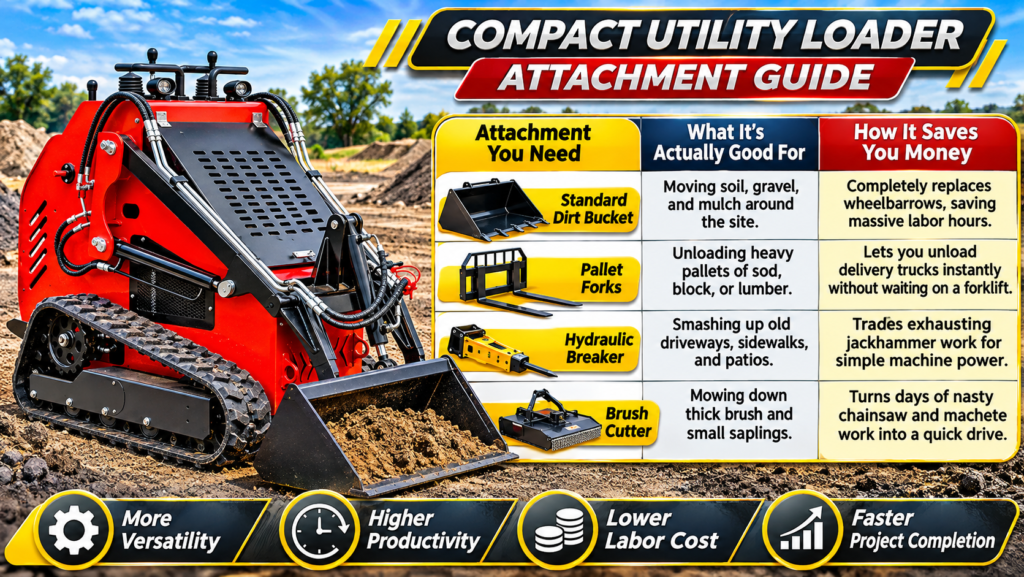
Table: Compact Utility Loader Guide
| Attachment You Need | What It’s Actually Good For | How It Saves You Money |
| Standard Dirt Bucket | Moving soil, gravel, and mulch around the site. | Completely replaces wheelbarrows, saving massive labor hours. |
| Pallet Forks | Unloading heavy pallets of sod, block, or lumber. | Lets you unload delivery trucks instantly without waiting on a forklift. |
| Hydraulic Breaker | Smashing up old driveways, sidewalks, and patios. | Trades exhausting jackhammer work for simple machine power. |
| Brush Cutter | Mowing down thick brush and small saplings. | Turns days of nasty chainsaw and machete work into a quick drive. |
Stand-On vs. Walk-Behind: A Compact Utility Loader Guide to Stance
When you’re finally ready to pull the trigger and buy one, the biggest debate you’ll run into inside any Compact utility loader guide is whether to get a stand-on or a walk-behind model. It sounds like a minor detail, but it completely changes how you operate on a daily basis. Stand-on models have a little spring-loaded platform hanging off the back that you ride on.
If you work on large properties and have to cover a lot of ground, this is usually the way to go. The platform acts like a shock absorber, so your knees and lower back aren’t taking the brunt of the rough terrain all day. Plus, being elevated gives you a much better view of what the bucket is actually doing, which is super important when you’re trying to do precision grading.
Walk-behind models, on the other hand, ditch the platform entirely. This gives the machine an incredibly low center of gravity. Why does that matter? Because if you regularly work on sketchy, steep hills or retaining walls, a walk-behind is significantly more stable. It hugs the ground.
It also makes the machine a tiny bit shorter, which can be the difference-maker if you’re working in ultra-cramped spaces. Ultimately, you just have to look at the kind of jobs you normally take on and decide if you’d rather save your legs with a platform or play it safe on the steep slopes with a walk-behind.
- Saving your joints: The suspension built into stand-on platforms absorbs the nasty vibrations from the tracks, making a 10-hour shift feel way less punishing on your body.
- Hugging the hills: Walk-behind units naturally sit lower to the earth, giving you way more confidence and safety when you have to track sideways across a steep grade.
- Easy joystick controls: Both styles have largely moved away from clunky old levers to smooth, pilot-operated joysticks, which means your hands won’t be cramping up by the time you load the machine back on the trailer.
Essential Maintenance for Peak Fleet Performance
Nobody likes talking about grease and filters, but we have to go there. A massive point to take away from this Compact utility loader guide is that skipping maintenance will absolutely destroy your profit margins.
When a machine breaks down on a Tuesday morning, your whole crew ends up standing around checking their phones while you scramble to find a mechanic. You’re paying wages for zero output, and your client is getting annoyed. The upside is that these compact loaders are surprisingly easy to wrench on. The engine compartments usually swing wide open, giving you direct access to everything you need to check.
The secret to making these machines last thousands of hours is a ruthless daily routine. Your guys need to be doing a walk-around every single morning before they even turn the key. You have to check the oil, look for hydraulic leaks, and knock the mud out of the tracks. It takes maybe five minutes, but it’s the difference between a $15 tube of grease and a $3,000 repair bill for a blown hydraulic pump. Keep it clean, keep it greased, and it will keep making you money.
- Grease is cheaper than metal: You have to hit all the pivot points, bucket pins, and loader arms with a grease gun every day to push the grit out and stop the metal from grinding itself to dust.
- Keep the tracks tight: If you let the rubber tracks get too loose, you’re going to pop one off the sprocket while turning in the mud, and putting a heavy track back on in the field is an absolute nightmare.
- Watch your hoses: Hydraulic hoses rub and vibrate. Checking them daily for wear means you can replace a $50 hose before it blows up and sprays expensive hydraulic fluid all over a client’s driveway.
Steering Your Success with SteerSkid Equipment Insights
Here at SteerSkid.com, our whole mission is to cut through the marketing noise and give contractors the real, unfiltered facts they need to build a killer fleet. Buying a machine is a big deal, and you can’t just buy the one with the coolest paint job.
You need to dig into the actual specs that dictate performance on the dirt: the rated operating capacity, the true hydraulic flow, the maximum pin height for loading dump trucks, and the machine’s overall weight. By using our deep-dive Compact utility loader guide, you can easily line up what a machine can actually do with the work you do every day.
We know that today’s contractors are dealing with tight margins and high expectations. You need equipment that is built tough, easy to fix when things go wrong, and versatile enough to justify the monthly payment.
Whether you end up grabbing a tracked model to float over muddy spring lawns or a wheeled unit to zip around hard pavement, upgrading to the right mini loader is a game-changer. It streamlines your whole operation and lets you bid on those tight-access jobs that the other guys simply have to walk away from.
- Stick to the proven brands: We help you look past the gimmicks and focus on machines from top-tier manufacturers that actually hold their resale value when you’re ready to upgrade in five years.
- Demand universal plates: Always make sure the machine has a universal quick-attach faceplate; otherwise, you’ll be locked into buying overpriced proprietary attachments from just one brand.
- Look for smooth power: The best machines have advanced hydraulic systems that let you drive, lift, and tilt the bucket all at the same time without the engine bogging down or stalling out.
FAQs About Compact Utility Loader
What is a compact utility loader?
Think of it as a shrunken-down skid steer. It’s a highly versatile, walk-behind or stand-on machine built to do heavy earthmoving and lifting in backyards and tight spaces where a normal-sized tractor or loader just won’t fit. You can snap on different attachments to the front, making it useful for digging, hauling, and trenching.
How much weight can these mini loaders actually lift?
It really depends on the size you buy. The smaller, lightweight walk-behind models can usually safely lift between 500 and 800 pounds. But if you step up to a beefier, stand-on model, you can easily pick up a pallet of block weighing anywhere from 1,000 to over 1,500 pounds. Always check the specific “rated operating capacity” before you buy.
Are they actually better than a standard skid steer?
Not necessarily better, just different tools for different jobs. A full-sized skid steer is what you want for massive commercial grading or loading full-sized dump trucks all day. A compact utility loader is what you use when you need to get through a 36-inch residential gate and do serious work without completely destroying the homeowner’s lawn in the process.
Do I need a special heavy equipment license to drive one?
Nope. In almost every state and jurisdiction, you don’t need a CDL or any special heavy machinery license to run one of these on a private job site. They are designed to be extremely user-friendly with simple joystick controls, which means you can train a new employee to safely run one in an afternoon.
What’s the absolute best model for a landscaping crew?
For landscaping, you almost always want a stand-on model with rubber tracks. The tracks spread the machine’s weight out over a larger area, so you don’t sink into soft mud or leave deep ruts in nice grass. The stand-on platform is great because landscapers usually need to jump off and on a dozen times an hour to move hand tools or check grades.
How much do these machines weigh for towing?
One of the best perks is their weight. Most of them weigh somewhere between 2,000 and 4,000 pounds. That means you don’t need a massive commercial hauler. You can safely tow them on a heavy-duty dual-axle utility trailer behind a standard 3/4-ton pickup truck, making logistics incredibly easy.
Can I use one to dig a house foundation?
Honestly, no. They are insanely strong for their size, but they aren’t meant for excavating an entire deep basement. However, they are absolutely perfect for digging shallow deck footings, trenching out french drains, or doing the final, smooth finish grading around a newly built foundation.