
Understand Skid Steer Undercarriage Components A guide
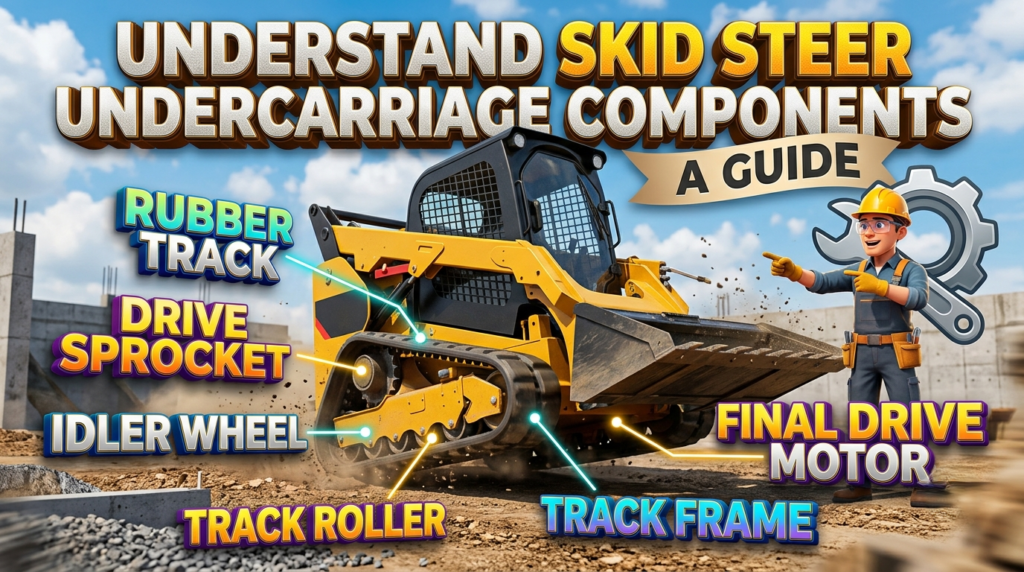
The Skid Steer Undercarriage Components compact track loader or mini skid steer loader is arguably the most pivotal, hardworking, and extensively used element of the entire machine. It supports the full weight of the equipment, takes on the impact from rough terrains, and essentially turns the raw engine horsepower into powerful ground-level pushing effort.
Despite its unmatched criticality for everyday work, unfortunately, this system is the one that gets neglected most frequently until a major breakdown stops the work on a very busy job site.
Understanding skid steer undercarriage components is not just a great technical skill for heavy equipment operators and mechanics; you might say it’s an absolute necessity from a business perspective. Since parts of the track assembly are constantly rubbing against each other, being exposed to soil that will wear them down, and loaded heavily mechanically, they represent a large share of your total machine’s lifetime costs.
If you can identify each individual component, get a grasp of how they function as a whole, and recognize the signs of component wear early, you will save yourself from huge expensive failures in the field.
Going Back to Basics: Rubber and Steel Tracks
The tracks are the outermost layer of your equipment, constantly in contact with the ground as they transfer the machine’s power and functionality to the earth. To achieve both good ground flotation and minimal soil compaction, they enclose the internal components, evenly distributing the entire machine weight over a large surface area.
Heavy-duty replacement tracks are made of steel cords embedded inside premium rubber compounds, without any vulcanization, so as to withstand heavy load capacities without stretching or splitting.
It is extremely important to pick the track pattern because, in general, matching your tracks with the main working environment greatly reduces the wear and tear of the components. It goes without saying that wide and smooth tracks perform very well on delicate turf and manicured lawns, whereas aggressive deep C-pad or block-pattern tracks are designed to come into close contact with mud, deep clay, and loose gravel.
Therefore, it is highly advised to regularly conduct visual checks to ensure that the internal steel lugs have not gotten loose, and the rubber carcass does not have any deep cut that would allow moisture to reach the steel cords and cause them to rust.
- Ground Flotation and Pressure: Tracks reduce the ground pressure down to as little as 4-5 PSI, which is what prevents the machine from sinking into the mud or soft sand.
- Internal Reinforcement: Premium rubber tracks come with internal steel cables continuously wound for providing a very high tensile strength that prevents the tracks’ stretching.
- Matching Track Patterns to Application: Linking the tread pattern (e.g., Combo, C-Lug, Zig-Zag, or Smooth) to the soil condition helps to optimize traction and lowers mechanical resistance.
Apply the Power: Sprockets and Drive Motors
The drive sprocket looks like a big heavy star-shaped steel wheel which is fixed on the machine’s hydraulic final drive travel motor. As the motor rotates, the sprocket draws in the deep teeth of the sprocket which lock tightly into the molded rubber lugs or steel links on the inside surface of the track, moving the track forward or backward.
Since the sprocket is the source of the active mechanical force, the teeth are always being worn down by dirt, sand, and rock packed into the track assembly.
This continuous grinding action gradually causes the metal to become worn out and the profile of the sprocket teeth to change from being broad and flat surfaces to sharp, hooked points.
Running a skid steer with sprocket teeth that are either worn out or severely hooked is very risky because it leads to the rapid destruction of the drive lugs inside your tracks and a huge loss of your machine’s performance efficiency. Apart from this, it is a great way to save your tracks and drive system by replacing your drive sprockets along with the installation of new rubber tracks.
- Direct Mechanical Transfer: The sprocket transforms hydraulic power from the final drive motor into mechanical torque to move the continuous track.
- The Wear Profile: Worn sprocket teeth gradually change from rounds “scallop” to sharp, hooked points, which can quickly cut into track lugs.
- Debris Evacuation: Good-quality sprockets incorporate recessed mud relief cuts between the teeth to allow for mud, packed clay, and small rocks to be squeezed out safely during rotation.
- Here is that sprocket wear guide organized into a clean, easy-to-read tabular format:
| Wear Status | Profile Visual | Description | Action Required |
| New Sprocket Profile | [|] | Broad, flat teeth surface | None (Optimal performance) |
| Moderate Wear Profile | (\) | Rounded, thinning teeth edges | Monitor closely; plan for future replacement |
| Critical Wear Profile | (L) | Sharp, hooked teeth | Replace Now (Risk of chain slippage/damage) |
Directing and Stabilizing: Front and Rear Idlers
Idler wheels are simply very big, unpowered steel drums that sit at the extreme front and back of the undercarriage frame assembly. They mainly serve to guide the rubber track smoothly into the track frame thereby helping to prevent the track from going off-line or slipping off sideways when making tight counter-rotation turns.
Besides that, idlers also function as very tough shock absorbers shielding the sensitive internal hydraulic drive motors from possible damage caused by hard hits against rock walls or concrete curbs.
Usually, the front idler wheel is mounted to a tough recoil spring mechanism and an adjustable hydraulic tension cylinder. When there is an obstacle which pushes the track up, the front idler moves a bit backward up against the tension of the spring thereby absorbing the impact force before it becomes strong enough to break your track or bend your frame. Making sure that the seals inside your idler wheels are healthy and their bearings are well lubricated is a must for your machine to continue rolling smoothly.
- Track Alignment Control: The large outer flanges on the idler wheels keep the track running straight along the main frame rails, which avoids any derailing issues.
- Impact Force Absorption: A front idler connected directly to a heavy internal recoil spring will help cushion the undercarriage from structural shocks.
- Dual-Bearing Architecture: Idlers built to be high-load have dual-tapered roller bearings and lifetime mechanical face seals to keep out wet mud and abrasive grit.
Uplifting the Load: Bottom Rollers and Triple-Flange Rollers
Besides their heavy-duty purpose, bottom rollers are also used as support for the weight of the machine and the load it is carrying. One main function of these solid steel wheels is to maintain the even contact of the machine with track, without any sagging between the front and the rear idlers.
Besides that, to help stabilize the track on uneven terrains, the rollers of your skid steer model could feature single, double, or even triple-flange designs.
Because they are the closest to the ground, bottom rollers are going to be constantly immersed in water, mud, slurry, and grit. A bottom roller with a sealed internal roller that has failed will very likely result in oil leakage.
And if this is the case, the internal bearings will overheat and eventually seize up which will make the roller to lock in place. Ultimately, the non-rotating bottom roller will cause the track assembly to be damaged as if it was a grinding block, leading to the formation of flat spots on the roller face as well as the rapid wear of the track lugs.
- Load Distribution Matrix: Multiple bottom rollers help to spread out the heavy operational weight of the loader evenly in order to prevent the formation of localized hot spots on the track.
- Flange Stabilization Styles: The right combination of single, double, and triple-flange configurations will function to prevent the track from rolling off even during steep side-slope operations.
- Permanently Sealed Maintenance: The best rollers are your premium ones that are filled with a select low-viscosity oil and sealed for life, despite needing visual leak checks now and then.
Tightening the Fit: Track Tensioners and Recoil Springs
Your track is held at the exact tension it was set to by the manufacturer thanks to the track tensioner and recoil spring which are working together silently and invisibly beneath your feet. Here are some facts about the track tension:
You can save a lot of money by wearing more efficiently your input and by replacing your parts much less frequently when the track is properly adjusted. On the other hand, if your tracks are so tight that the fuel gets wasted and your hydraulic system gets strained, the component wear will also be accelerated on all the way the bearings and the sprockets.
Most modern mini skid steer loaders have track tension that can be adjusted simply by either adding or releasing the heavy-duty grease through a special adjustment valve. When the grease is pumped into the internal tension cylinder, the front idler wheel is forced forward thus tightening the track layout.
Besides this, coupled with a giant steel coil recoil spring of high tensile strength, this system can endure instances of sudden increase in track pressure without breaking any components or ripping the track.
- Grease-Actuated Regulation: Maintaining the track tension is something that can be easily done by injecting heavy-duty chassis grease into a sealed piston cylinder of the hydraulic type.
- Mechanical Overload Protection: During stone ingestion, the heavy coil recoil spring will instantaneously compress resulting in the track being saved from snapping under tension.
- Pre-Load Structural Engineering: By applying constant pressure to the track system, tensioners help in minimizing the high-frequency vibrations that cause operator fatigue.
Full List of Skid Steer Undercarriage Components Functions
In the table below, I have summarized the key functions of the skid steer undercarriage components to help you monitor your preventive maintenance inspections and recognize worn parts easily.
| Undercarriage Component | Core Mechanical Function | Primary Wear Indicators & Symptoms | Expected Replacement Action |
| Rubber / Steel Tracks | Distribute machine weight, provide traction, reduce ground pressure | Deep dry-rot cracks, missing drive lugs, exposed internal steel cords | Replace when lugs tear or cords show |
| Drive Sprockets | Convert hydraulic motor torque into track driving force | Pointed or hooked teeth, thin profile, teeth jumping or slipping | Always replace alongside new tracks |
| Front & Rear Idlers | Guide track alignment, absorb structural impacts | Flat spots on outer rim, side-play wobble, visible oil seal leaks | Replace when bearings freeze or leak |
| Bottom Rollers | Support machine payload weight, maintain low center of gravity | Flat spots, seized rotation, uneven outer flange wear | Replace individually upon bearing failure |
| Track Tensioners | Maintain track tension via grease cylinder and recoil spring | Inability to hold grease pressure, frozen spring, track sagging | Rebuild cylinder seals or replace spring |
Frequently Asked Questions (FAQ) – Skid Steer Undercarriage Components
How long do rubber tracks generally last for skid steer loader use?
Generally, the operating time of good-quality rubber tracks is 1,200 to 2,000 hours. However, it must be pointed out that the lifetime is dependent on various factors such as the work method, machine storage, and the main component maintenance of the undercarriage. Severe operations that involve working on abrasive concrete, sharp demolition rubble, or jagged bedrock can reduce track life to as few as 800 hours. However, performing work on soft topsoil, sand, and carefully kept turf can extend track life for up to 2,500 hours or more.
How frequently should I check and regulate the tension in my skid steer tracks?
You are advised to check your track tension every 10 to 50 operating hours, or at least once a week during periods of active work. Besides that, you should make sure to check the tension when there is a change of work environment, for example, from thick mud to hard-packed stone. Always consult your machine’s manual for track sag measurement and check if the measurement exceeds the factory specifications by using a straight edge along the top track rail.
Is it necessary to change the sprockets when fitting new tracks?
Definitely, it is best to replace your drive sprockets each time when you get a new set of rubber tracks. The damage to the internal drive lugs of the new track will be caused instantly when the brand new track runs over a worn, hooked sprocket; not only will it lead to premature wear but also it will void your track warranty. By changing sprockets together with your tracks you assure the even wear of your whole drive system.
What makes a skid steer track derail or come off?
Usually, a track will derail because of too slack track tension, worn out idler flanges, or failure to use the right operating techniques on rough terrain. Making a sharp turn while driving over deep obstacles like rocks, curbs, or tree roots can easily cause a loose track to get off its alignment path. One must keep the undercarriage clean of mud that is compacted and stone debris in order to avert problems of derailing.
Is it possible to combine different brands of undercarriage parts?
Some aftermarket rollers for bottom and idler wheels have been manufactured to share universal dimensions, still, the safest thing to do is to buy your replacement parts from a trustworthy provider like steerskid.com by matching high-quality products. If you mix components that have minor dimensional differences you may end up with tracking errors, uneven wear patterns, and premature system failures. Before installing replacement components always get the exact model compatibility verification.
What are the signs that indicate the final drive travel motor is going to be defective?
The most obvious symptoms that indicate a failing final drive motor are that a particular side is noticeably losing pushing power, there will be loud grinding or squealing noises during the operation of the machine, and finally, oil leak from the main sprocket hub seals. If on level ground without changing direction your skid steer is constantly drifting or pulling to one side, the travel motor may be losing hydraulic pressure and that will require professional attention immediately.
How does packed mud and dirt compromise the validity of an undercarriage assembly?
When the track frame hardens with the inside of compacted mud, wet clay, and stones, it then acts like an abrasive grinding cream against the parts made of steel that are rotating. The residues become tightly packed inside the sprocket teeth, leading to an artificially over-tensioned track and causing strain on the hydraulic drive motors. Five minutes spent at the end of the day cleaning with a scraper or pressure washer will definitely save you thousands of dollars in premature wear costs.