
Track Tensioning 101: Prevent Costly De-Tracking Incidents on Muddy Terrains
Running compact track loaders or skid steers in very muddy conditions is no small feat — operational challenges are pretty much endless. Even though rubber tracks are amazing for providing the necessary flotation and traction required for going through deep, liquid mud, these same conditions can significantly increase the possibility of a track being thrown with the proper skid steer track maintenance.
A single de-tracking event not only brings your work to a halt but may also cause damage to expensive undercarriage components, disrupt labor schedules, and even lead to serious safety-related issues for the personnel who have to do repairs in the field.
Learning a bit about the basics of skid steer track maintenance is an excellent first step in helping you avert the major problems that can come with operating on muddy sites. Since mud is abrasive and cohesive in nature, it tends to pack very tightly into the undercarriage which can change the operating tension of your track system.
If you base your skid steer track maintenance operations around standard factory tension settings without accounting for the sticky and fluid work environment of mud, then really, your machine is simply one more expensive tracking mishap away from disaster.
The Costly Anatomy of a De-Tracking Incident
The financial ramifications of your skid steer or compact track loader throwing a track on a muddy site are much more than just losing immediate machine hours available for billing. Excellent skid steer track maintenance is aware of the fact that a derailment’s mechanical shock can bend or break key undercarriage components.
With an in-depth understanding of how a track can be derailed, operators will appreciate why strictly enforcing a maintenance schedule is so good for the bottom line.
- Smashed Undercarriage Components: With a track out of proper alignment, the steel drive sprocket teeth, which are hardened, can very roughly grind against the combination of exposed steel cords inside the track and the rubber drive lugs. Failure to conduct timely skid steer track maintenance not only allows this friction to cause irreparable damage to the internal steel reinforcements of the track but also results in the splintering of teeth on the sprocket which is a costly parts replacement situation.
- Lost Time Due to Major Project Disruption: Nobody likes to be down for the count, particularly when a heavy rubber track getting stuck in deep, unbreakable mud means that even with the help of an assisting machine to do the heavy lifting, it could be a several-hour-plus task. While your star player is sidelined due to a failure in skid steer track maintenance, your crew loses the benefit of their production and that of course, can quickly snowball into you having to pay penalties for your delayed project as per the contract terms.
- Permanently Damaged Rubbers Tracks: Tracks are made of a rubber compound with steel cable strings embedded in them for added strength. So, when a track suddenly comes off the front idler or rear sprocket with a heavy load, it’s a real stretch for those internal cords. They bend, break, get chemically damaged, and so forth. That basically weakens the track framework and leads to frequent derailments.
How Muddy Terrain Changes Track Tension
Muddy ground causes a complete change in the way the undercarriage of your machine interacts with its rubber tracks. Normally, dirt or gravel falls away freely from moving parts, but wet clay and mud stick so aggressively to every surface, making special skid steer track maintenance really important to ensure that factory tension levels are overridden.
- The Mud-Packing Material Effect: As the machine drives through wet mud, the material is continuously forced into the spaces between the drive sprocket, mid-rollers, and front idler. This packed-in mud layer acts like a thick, solid spacer, forcing the track outward and artificially over-tensioning the entire system to extreme levels.
- Rapid Under-Tension Traps: Conversely, when an operator transitions from thick mud onto hard, dry ground, the caked-on material quickly breaks away from the undercarriage. This sudden loss of packed material instantly creates extensive slack, demanding immediate skid steer track maintenance to correct the track before it drops below safe operating tolerances.
- Severe Side-Load Slippage Risks: Fluid mud offers minimal lateral resistance when a machine executes a pivot turn. As the machine turns, the slick mud forces the track to slide sideways against the rollers, allowing the internal tracking lugs to climb right out of the guiding rollers and throw the track completely.
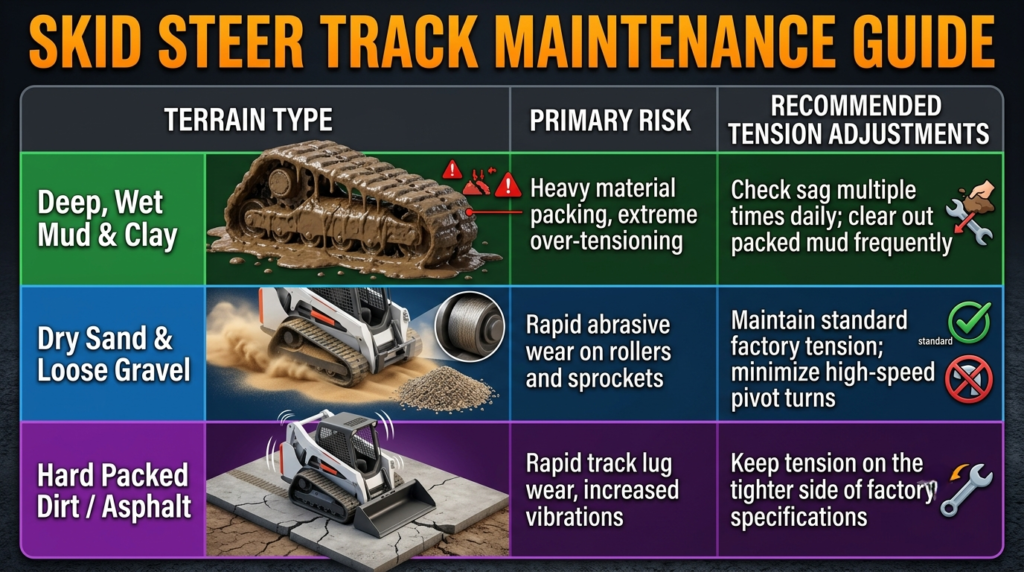
Table: Skid Steer Track Maintenance
| Terrain Type | Primary Undercarriage Risk | Recommended Tension Adjustments |
| Deep, Wet Mud & Clay | Heavy material packing, extreme over-tensioning | Check sag multiple times daily; clear out packed mud frequently |
| Dry Sand & Loose Gravel | Rapid abrasive wear on rollers and sprockets | Maintain standard factory tension; minimize high-speed pivot turns |
| Hard Packed Dirt / Asphalt | Rapid track lug wear, increased vibrations | Keep tension on the tighter side of factory specifications |
Step-by-Step Guide: Checking and Adjusting Track Tension in Mud
Skid steer track maintenance in mud really means immersing yourself in adjusting the tension regularly throughout the day, it is not just a matter of a quick look at the beginning of the day. This step-by-step procedure, which is based on actual use, will help you effortlessly measure and adjust your track’s sag during heavy weather.
- Lift the Machine Frame Above Ground: Ideally, park the machine on a flat piece of land. Use the front loader bucket to lean hard against the ground, lifting the front of the undercarriage well off the surface, and stack sturdy wood blocks under the rear part of the frame to ensure the whole assembly is stable.
- Measure the Central System Deflection: Come to the middle roller of the hanging undercarriage and take a distance measurement between the roller’s lower surface and the top of the track’s inner lining. This is the basis for regularly scheduled skid steer track maintenance, and you should reference it against the manufacturer’s recommended numbers.
- Perform Grease-Valve Operations Properly: At the track frame, locate a small door that opens to reveal a grease valve cylinder. If you’re doing skid steer track maintenance to re-tighten a loose track, you can use a grease gun to add chassis grease into the valve, causing the front idler to move forward. If you want to ease an over-tightened track, you gently open the valve, thereby allowing released grease to back the front idler away.
Warning Signs Your Track is Preparing to Deraill
Some of the very last moments before a track is thrown completely can be detected fairly easily by observing the machine doings. Daily preventative inspections as part of your regular skid steer track maintenance shall in fact give the operator the chance to plan for repairs, instead of calling for help when the failure has happened and it’s too late.
- Clicking and Popping Sounds Beyond Normal Levels: If at any point while operating, you start to hear the undercarriage make clicking, snapping, or popping noises at regular intervals, this may be due to the sprocket teeth being out of alignment and thus grinding against the track lug teeth. Get off right away, perform emergency skid steer track maintenance, and investigate for mud buildup or loss of tension.
- Large Variations in Machine Direction/Steering: When one side of the track becomes loose or uneven, the machine will start to naturally pull or drift to that one direction during straight driving. Physically, it’s a pulling sensation that indicates it’s time for skid steer track maintenance because the loose track is slipping on its drive sprocket and losing traction.
- Visual Check of Guide Lug Misalignment: Run through your cab to regularly survey the internal guide lugs of the track. If you find some are riding up onto the outer edges of the mid-rollers or front idlers, it’s a clear sign that they are out of alignment as well as possible track raising to the rollers; immediately perform the next skid steer track maintenance interval before you turn the machine again.
Operational Best Practices for Muddy Job sites
Saving a track from throwing is not just a matter of being lucky, it is something that results from a good combination of operating smartly and structural skid steer track maintenance activities. Without a doubt, proper training will show how correct operations in muddy conditions can instantly reduce undercarriage wear.
- Steer Clear of Quick, High-Speed Turning: Pivoting sharply, and at high speed, in deep mud only forces material directly into the undercarriage as well as side-loading the track severely. So, take wide and gentle turns, keeping the machine moving at a steady pace to minimize the amount of twisting the track undergoes.
- Limit the Amount of Traveling in Reverse: The structural design of skid steer undercarriages favors forward movement. Using the machine in reverse through thick mud results in a change of the tension distribution, which, in turn, causes the track to be pulled loose at the bottom and, thus, accelerates the need for non-scheduled skid steer track maintenance.
- Set up Scheduled Clean-Out Sessions: Establish a rule dictating operators to stop and clear away mud packed into the track assemblies via scraper tool every few hours. Apart from supporting your general long-term skid steer track maintenance agenda by preventing artificial over-tensioning, this also enhances the lifespan of your track components.
FAQs – Skid steer track maintenance Guide
How does proper skid steer track maintenance reduce downtime in muddy conditions?
Regular skid steer track maintenance is a good way to keep track tension at safe levels even under the forces of mud packing. Operators cannot overlook track sag checks and cleaning of the track throughout the day, as this will ensure that the track’s physical expansion does not reach its breaking point, and hence, the track remains well-guided and firmly retained.
How tight should the tracks be on a compact track loader?
Tensions may vary depending on manufacturers, but a simple little tip gleaned from skid steer track maintenance guidelines states that the track ‘sag’ gap measured at the center roller should be about 1/2 to 1 inch (12mm to 25mm). For the exact figures, refer to the operator’s manual of your machine. Remember: very tight tracks will cause accelerated wear of the rollers while too loose tracks may lead to instant de-tracking.
Can a failure in skid steer track maintenance cause damage to the machine’s hydraulics?
Indeed, failure of skid steer track maintenance can lead to over-tensioning of tracks, which will put heavy and unnecessary loads on the drive motors, internal roller bearings, and front idlers. In such high tension situations, hydraulic drive motors are forced to work very hard, which results in the system overheating, higher fuel consumption, and sealing elements getting worn out.
How often should I check my track tension when working in wet clay or mud?
In situations involving extremely muddy or sticky clay, skid steer track maintenance should be performed a minimum of two times per day: once before the morning work session and then again halfway through the day’s work. Mud accumulates quite fast in frames, but it can also get washed away quite abruptly, so your actual track tension situation during an 8-hour shift can change quite a bit.
What are the main signs that my track sprockets or idlers are worn out?
Tell-tale signs for need of parts replacement during regular skid steer track maintenance are sprocket teeth becoming sharp-pointed or very thin and visible flat spots or deep gouges worn into mid-rollers and front idlers. Worn parts lose the ability to perfectly align the track, thereby greatly increasing the risk of a thrown track.
Should I adjust my track tension differently for winter mud versus summer dirt?
Yes, you should change your skid steer track maintenance routine according to seasons. The difference between wet winter mud and freezing clay which tend to pack tightly in the undercarriage requiring frequent monitoring and cleaning to avoid excessively over-tightening, and dry summer dirt which cleanly sheds from the track keeping the tracks in closer to standard factory tension levels is quite large.