
How to identify genuine vs counterfeit skid steer replacement parts?
Looking after a skid steer is a major task and the quality of every single part will determine how long your machine lasts, how safe it is, and how efficient it is at running. Heavy equipment industry has been flooded with copycat and counterfeit parts and it has become harder than ever for owners and operators to tell besides good and essential parts, dangerous fakes. Getting the right skid steer replacement parts is not just a matter of saving money; it’s a matter of making sure that your loader performs at its best without the risk of a major failure.
Identification of Genuine Skid Steer Replacement Parts
At SteerSkid, we know that downtime is the enemy of your productivity. That’s why we advise against using counterfeit parts that may cause leaks in the hydraulics, overheating of the engine, and even collapse of the structure, which are very dangerous situations for the operator.
On top of that, you have to be very observant with the subtle differences in manufacturing, packaging, and documentation. Here, we present a detailed guide on how to tell genuine parts from counterfeit ones, which will help you to keep your machinery in top condition, while avoiding the costly consequences of seemingly “cheap” knock-offs.
The importance of using genuine skid steer replacement parts
Genuine parts are the only ones that can ensure that your machine maintains the original factory specifications. Also, counterfeit parts will hardly ever match the precision required for high-pressure situations, unlike genuine parts that are built to work together perfectly as a single system.
- Optimized Performance: Genuine parts are produced to the most accurate dimensions to ensure a perfect fit and the right hydraulic pressure and engine power for heavy lifting are maintained.
- Enhanced Safety: Fake bolts, pins, and gaskets are typically manufactured from low-quality metals that may break or melt under stress, which in turn can lead to dangerous equipment failure on the worksite.
- Warranty Protection: Use of counterfeit parts usually results in cancellation of the manufacturer’s warranty, which means you will have to pay for any secondary damages caused by the part’s failure.
Packaging and branding discrepancies analyzing
It is very important to inspect the cardboard of the packaging as that is what can raise suspicion immediately on whether you have got a counterfeit piece or not. In some cases, criminals manage to do a very good job, but mostly they reveal themselves by such things as the use of low-quality cardboard and the poor print.
- The quality of the print and the fonts: Presence of a logo that is not very clear, ink that has faded, or fonts that do not match each other is a strong indication of a fake. Real manufacturers rely on high-quality offset printing, whereas fakes typically reveal low-resolution digital printing or “ghosting.”
- Spelling and Grammar: It is very common that counterfeit packaging will have some typos, especially in the instructions or the brand name. Therefore, checking the spelling of the manufacturer’s name and part description can be very helpful.
- Holographic Seals: Recently, numerous leading brands incorporate 3D holographic tags or tamper-evident seals. If the hologram fails to change color or depth upon tilting, it is very likely a copy.
Physical inspection: material and build quality
Even if this one may seem like a very little thing, it can tell you a lot. You might want to do a comparison by side of the new with your old part. Besides this, authentic are subjected to a much stricter quality control process than even the best counterfeit ones.
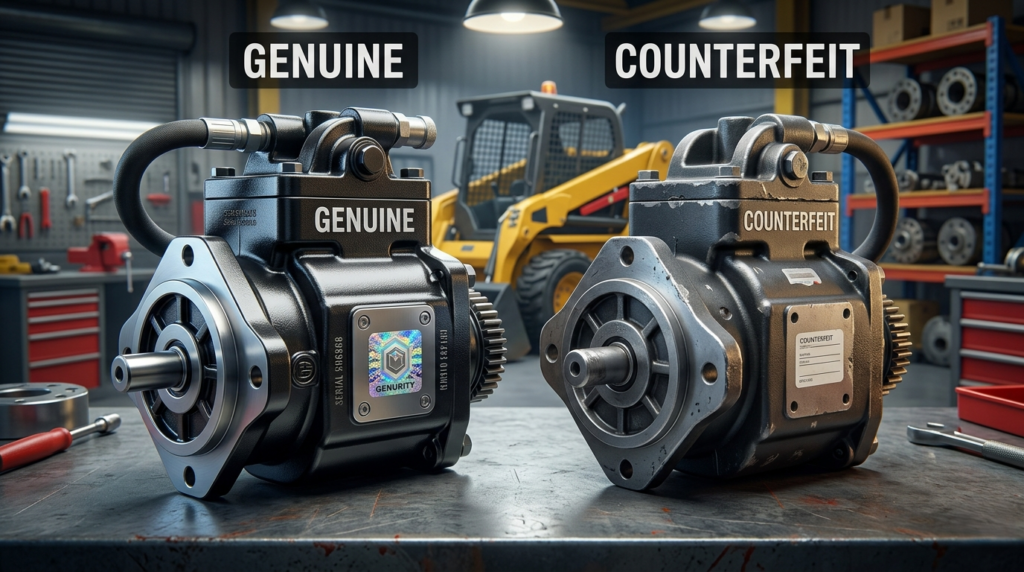
- Weight and Density: It is a very common practice for counterfeiters to make the parts lighter because they use recycled metals or make the walls thinner. Thus, if you pick a hydraulic pump or an engine part and it feels significantly lighter than the original one, it definitely doesn’t meet the required material strength.
- Machining and Finish: You should be able to find rough edges, burrs, or incomplete surfaces easily. Authentic parts graduate top grade finishes and exact threading. If you spot “pit” or a grainy surface on the metal, it likely means that the casting method was of low quality.
- Color Consistency: Most manufacturers’ color schemes are very distinct. Therefore, if your skid steer replacement parts part’s shade is slightly off or the paint gets scratched very easily, this is a clear indicator that you are looking at a non-OEM finish.
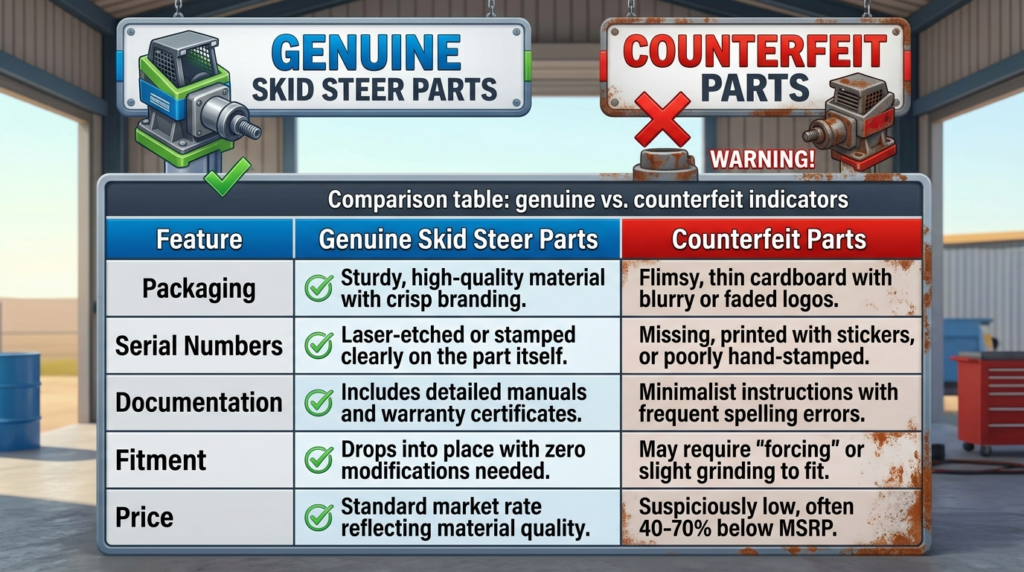
Comparison table: genuine vs. counterfeit indicators
| Feature | Genuine Skid Steer Parts | Counterfeit Parts |
| Packaging | Sturdy, high-quality material with crisp branding. | Flimsy, thin cardboard with blurry or faded logos. |
| Serial Numbers | Laser-etched or stamped clearly on the part itself. | Missing, printed with stickers, or poorly hand-stamped. |
| Documentation | Includes detailed manuals and warranty certificates. | Minimalist instructions with frequent spelling errors. |
| Fitment | Drops into place with zero modifications needed. | May require “forcing” or slight grinding to fit. |
| Price | Standard market rate reflecting material quality. | Suspiciously low, often 40-70% below MSRP. |
Serial number verification and technical document review
Apart from being used for inventory control, serial numbers allow manufacturers to track a particular part’s production batch and date.
- Number Alignment of Parts: Compare the part number on the box with the number that is engraved on the component. In counterfeit items, these numbers are either different or the number is not listed in the manufacturer’s digital catalog.
- QR Codes and Digitally Verified: A lot of new parts will have a QR code which on scanning open a secure verification page. If the code cannot be scanned or lead to a generic “404 page,” it’s a fake.
- Instruction Manuals: Authentic parts come with detailed diagrams and professional guides. You should be highly suspicious if you receive only a poorly copied sheet of paper without any diagrams.
White box parts at low cost – what risks do they pose?
Though “aftermarket” parts represent a genuine category, there is a huge difference between a dependable aftermarket brand and a “white box” counterfeit. Counterfeits will do anything to dupe you into thinking that they are the original brands.
- Hydraulic System Failure: A poor quality seal or hose can make you lose pressure suddenly, which can result in arms of the lift “drifting” or even in a complete rupture that would spray hot oil everywhere.
- Engine Longevity: Fake filters will usually have fewer pleats and be made of lower quality material, allowing abrasive particles to cause cylinder wear in the engine prematurely.
- Impact on Resale Value: Using unverified or counterfeit parts can reduce the resale value of your skid steer, as experienced buyers will want to see a history of genuine maintenance.
FAQ’s: Skid Steer Parts Authenticity
Are aftermarket skid steer parts the same as counterfeit parts?
No. Genuine aftermarket parts are sold under their own brand name and they either meet or exceed OEM standards. Counterfeit parts on the other hand are illegal knock-offs that deceptively use a brand’s logo without permission to trick buyers.
Why is the price of genuine parts so much higher than fakes?
Price covers the use of high quality alloys, detailed engineering, and thorough safety testing. Fakes make use of cheap materials and avoid the entire quality control procedure.
Can I verify a part’s authenticity using its serial number?
Absolutely. The largest manufacturers provide online platforms or apps where you can input your serial number to check that the part was indeed made at their factory.
What are the signs of a counterfeit hydraulic pump?
Signs often include poorly cast housing, misaligned bolt holes, and over 10% difference in weight compared to the original.
Do counterfeit parts come with a warranty?
Typically, they do not. Although a seller might promise a “warranty,” very often it is practically impossible to make a claim. Genuine parts, and only genuine parts, are backed by manufacturer warranties that cover both parts and potential labor work.
Where is the safest place to buy skid steer replacement parts?
Authorized manufacturer dealers are the primary safest sources of products. Besides them, industry specialists with a known and verified supply chain and reputation for quality such as SteerSkid can be trusted as well.
Conclusion: Protecting your equipment with skid steer replacement parts
Spotting fake skid steer parts involves training your eyes to source professionally and with vigilance. Careful checking of packaging and inspection of the parts’ material quality, coupled with serial number verifications, can help you dodge the dangerous and expensive consequences of fake parts.
Keep in mind that a too good to be true offer is most likely a lie. The quality of the parts that you install is the first step in protecting your skid steer. Our team at SteerSkid is dedicated to supplying only top-tier components so that your loader can remain safe, reliable, and efficient for a long time.