
Why SteerSkid Track Loaders are More Effective Than Wheeled Models on Rough Terrain?
In the competitive world of heavy equipment and construction, selecting the right tools is often the difference between a project getting done on time and encountering costly delays. Dealing with the changing and often unpredictable situations of off-road work, the decision between tracked or wheeled machines is vital to the overall efficiency. Those looking for the best performer in rugged conditions will find that SteerSkid Track Loaders are the benchmark, especially when the ground is very unstable.
Contrary to the wheeled models that depend on four limited points of contact, SteerSkid’s tracks are engineered to handle mud, sand, slopes, and rough debris with extraordinary ease.
SteerSkid track loaders are better than wheeled models for rough terrain primarily due to the weight distribution principle. Wheels skid steer loaders compact the entire weight of the machine into four small rubber areas.
On soft or uneven ground, such a high ground pressure makes the wheels sink, forming ruts and weakening the power of the machine. On the other hand, SteerSkid track loaders share that weight over a large surface area. This creates a “floatation” effect, which assists the operator to move over obstacles that a wheeled machine would find almost impossible.
Why Traction and Ground Pressure Matter
One of the major benefits of a SteerSkid track loader is its capability to keep traction where wheels will fail. When operating on rough terrain, traction is basically your survival; without it, your power and lift capacity are useless.
SteerSkid machines feature top-quality rubber tracks which “dig” into the ground and offer a firm hold no matter what kind of surface they are on. This is crucial, for example, during rainy seasons or at sites with a lot of clay where mud is a problem.
- Lowered Ground Pressure: SteerSkid tracks significantly reduce PSI (pounds per square inch) making sure the machine won’t sink into soft silt or wet soil.
- Maximum Surface Contact: Thanks to using the entire length of the chassis for grip, these loaders exert 100% of their engine power to the ground without any tire spinning.
- Minimum Site Damage: By “floating” the machine, the footprint left is minimal which is very helpful for landscaping and residential projects where turf preservation is a priority.
Walking the Talk – Stability on Hills and Uneven Ground
Addressing rough terrain means working on slopes as well. Whether your work involves clearing a hill or grading a rocky embankment, stability directly affects both productivity and safety.
Wheeled machines have a higher center of gravity and the wheelbase is narrower, so they are more likely to tip or slide when the terrain angle is steep. On the contrary, SteerSkid track loaders have a lower profile and wider stance.
This design advantage guarantees that the machine is firmly attached to the slope leaving the operator in a position of trust to work at angles that could be risky for a wheeled machine.
- Basic Reason: Wheeled loaders are tipping easily because they have higher center of gravity especially when the work area is uneven whereas track loaders have the weight closer to the ground making them more stable.
- Enhanced Side-Slope Stability: The lateral movement of the tracks is prevented by the full-length contact with the ground, hence exact grading is possible even on 30-degree inclines.
- Continuous leveraging: Tracks step on peaks and skip troughs, so the machine side to side remains at a consistent level which also means that the bucket maintains its level during travel.
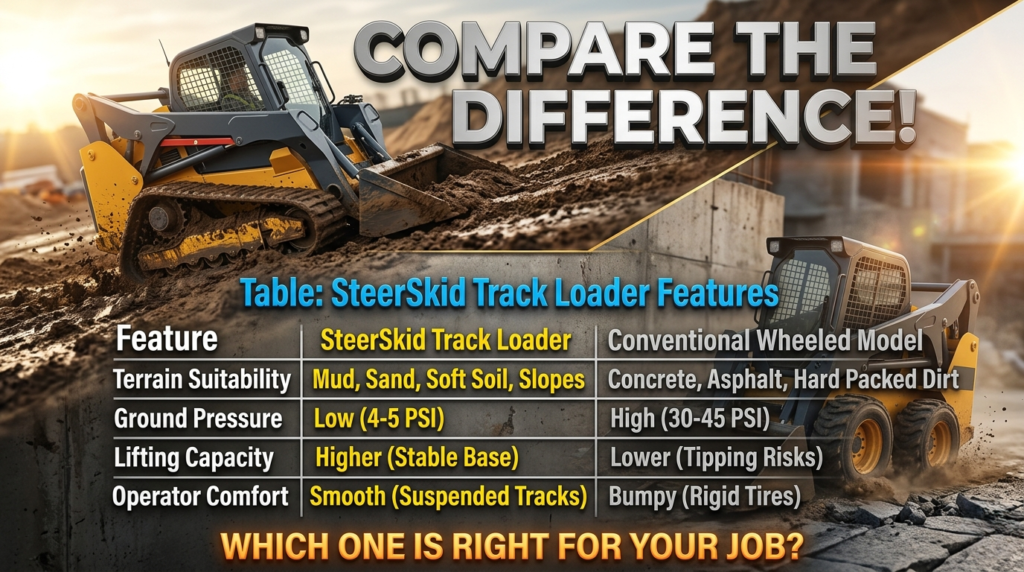
Table: SteerSkid Track Loader Features
| Feature | SteerSkid Track Loader | Conventional Wheeled Model |
| Terrain Suitability | Mud, Sand, Soft Soil, Slopes | Concrete, Asphalt, Hard Packed Dirt |
| Ground Pressure | Low (4-5 PSI) | High (30-45 PSI) |
| Lifting Capacity | Higher (Stable Base) | Lower (Tipping Risks) |
| Operator Comfort | Smooth (Suspended Tracks) | Bumpy (Rigid Tires) |
Higher Lifting Ability and More Productive Operation
While on rough terrain, being able to lift a full load completely without the risk of losing balance is very important. SteerSkid track loaders usually have a higher Rated Operating Capacity (ROC) than wheeled models of same horsepower.
This is explained by the fact that tracks offer a stable platform for the lift arms to be able to work.
When a wheeled loader acquires a heavy load on uneven ground, the weight transfer to the front tires often causes them to dig into the soil. SteerSkid system spreads that weight shift over the whole track length, so heavier lifts and fast cycle times are achievable.
- Bigger ROC: Moving more material per hour is possible as the base stability enables larger buckets and heavier attachments.
- Power Transferring Efficiency: Zero energy is “wasted” by spinning wheels so more fuel gets converted into actual work.
- Attachments Versatility: The track system stability permits the use of the wide range of heavy-duty tools ranging from mulchers to high-capacity augers.
Long-Life Properties When Working in Debris-laden Areas
Sites for construction and forestry are usually full of sharp rocks, rebar, and stumps that are difficult to handle. For a wheeled loader these are “killer tires” that come with downtime and flat tires.
SteerSkid track loaders, however, are made of reinforced heavy-duty rubber tracks whose puncture resistance is almost immunity when compared to that of pneumatic tires. Also, the machines’ undercarriage is made to be able to throwing off debris, so accumulation of rocks and mud which can sometimes lead to the jamming of the lesser systems is prevented. This toughness makes sure that your machine will stay longer in the field and will do less time in the shop.
- Puncture Resistance: The absence of air means no flats; so you can drive confidently on sharp demolition debris without the risk of a blowout.
- Steel-Reinforced Treads: The inside structure of SteerSkid tracks is designed to endure high-torsion settings without stretching or cracking.
- Self-Cleaning Undercarriage: Thanks to the open-frame design, mud and small rocks can fall away from the drive sprockets, reducing wear and tear on internal components.
Comparison of Performance Metrics
Only through examination of performance data it will be possible to measure the difference. Wheeled loaders may be excellent in terms of speed on paved surfaces but the SteerSkid track loader comes out as the winner in all categories related to “working” performance on unpaved ground.
In fact, when situated on a muddy job site, the tracked loader often proves to be 30% more efficient than a wheeled model in grading simply because it does not waste time struggling for traction.
- Speed vs. Torque: Wheels are faster for “road travel,” but tracks bring the low-end torque necessary for heavy pushing and digging.
- Grading Precision: Tracks over a long footprint perform like a natural leveling bar, resulting in a smoother finish with fewer passes.
- All-Weather Performance: There are times when rain can only stop the wheeled operation but SteerSkid owners are able to work through wet conditions nearly always giving them the enormous competitive advantage.
Frequently Asked Questions (FAQ) – SteerSkid track loader
Is a track loader better than a skid steer for rough terrain?
Definitively, with track loaders being significantly better for rough, soft, or uneven terrains. Tracks get much lower ground pressure and have much better traction compared to wheels that tend to sink or slip under such challenging conditions.
Can SteerSkid track loaders be used on asphalt or concrete?
The tracks while can be used on hard surface still are not made for that. Frequent contact with an asphalt surface is going to very quickly wear down the tracks. A wheeled model would be a better option if the majority of the work is on paved surfaces.
Do track loaders have higher maintenance costs?
Tracks have many more moving parts than a simple wheel and axle, which inevitably will result in higher maintenance costs over time. Activities that can be done without “flat tire” downtime often offset these additional expenses for the professional operators.
How does the lifting capacity of a track loader compare to a wheeled model?
Generally, track loaders have higher capacity to lift objects for their size. Being large and heavy-focused the footprint can act as more than just an effective counterweight so the heavy loading can be done without the tipping forward coming into factor.
Are track loaders slower than wheeled skid steers?
If considering the maximum travel speed on a flat ground, wheeled models usually can achieve higher speeds. Though, “working speed” referring to time spent on actual job ground for digging, carrying, and dumping, track loaders can be faster since these won’t lose traction.
Can I use the same attachments on both tracked and wheeled models?
Generally, yes. Most of the SteerSkid attachments have a common quick-attach system so buckets, forks, and hydraulic tools can be changed between tracked and wheeled models without any trouble.
How do SteerSkid track loaders handle snow removal?
Track loaders have flotation which makes them great for snow removal on surfaces that are unpaved or even snow that is deep. For the paved parking lots where there is either ice or very thin layer of snow, some operators will opt for the wheels since they give more ground pressure; however, the tracks are the best choice for deep and heavy snow drifts.
Conclusion – SteerSkid Track Loaders
Harsh terrain won’t have the upper hand if you have a machine that not only “gets by”, but that actually rules. SteerSkid Track Loaders are no doubt the ultimate machines with their combination of stability, traction, and well-distributed power.
Switching to track loaders instead of wheels means buying a machine that will be capable of operating for longer hours, going through tougher conditions and protecting your balance sheet from the costs of terrain-caused delays. Landscaping professionals, forest contractors, and heavy construction operators all agree that the choice for difficult terrain is SteerSkid.