
High-Torque Earthworks Techniques: Making the Most of a Skid Steer Auger Attachment to Drill Fences and Pergolas
Creating lasting outdoor features such as residential fences and timber pergolas involves more than just having good-quality wood and reliable brackets. Actual structural durability starts completely underground. The stability of these vertical constructions against lateral wind forces, frost heaving, soil movements, etc., relies mainly on the quality of your initial excavation of the ground.
Besides that, labor-intensive manual digging of deep footings with the use of manual clam-shell diggers tends to be very tiresome and slow, not to mention that such digging methods result in the creation of irregular holes that waste concrete and lack strength.
Today, in order to get the maximum lifespan of their structures and, at the same time, obtain the perfect line alignment, contractors and property owners alike, vest their trust in powerful machinery.
Adding a Skid steer auger attachment to your compact track loader or skid steer will in fact turn your equipment into a high-precision drilling rig. The integration of a heavy-duty Skid steer auger attachment can completely revolutionize your work process, turning multi-day, labor-intensive digging tasks into clean, precise mechanical processes that are done in just a few seconds per hole.
Without a doubt, spending a significant amount of time manually wrestling tools can be the last thing your construction crew will want to be doing if they have access to a well-selected Skid steer auger attachment that can even help them clear the whole property line in a fraction of the time.
Top Features – Skid Steer Auger Attachment to Drill Fences and Pergolas
1. Soil Features and Hydraulic Drive Selection
Without a doubt, the geological profile of the earth comprises different resistance patterns by which a drill bit is affected in terms of penetrating the ground. Having a soil profile of soft, loamy topsoil is completely different from dealing solid plastic and sticky clay, or even tightly compacted glacial till, which contains native river rock.
Therefore, choosing the wrong gear drive for your Skid steer auger attachment can result in the premature wear of the tool, overheating of the equipment, or the rotating bit being stalled due to underground friction.
Setting your machine’s auxiliary hydraulic output to the working mechanics of your Skid steer auger attachment is a decisive step toward operational success.
Most quality Skid steer auger attachments use one of the following two mechanical systems to convert the loader’s hydraulic lines rotational energy to the drilling flighting:
- Planetary Gear Drive Systems: These configurations of high-torque make it possible for a Skid steer auger attachment to convert the raw hydraulic force of your machine into maximum low-speed twisting force. Their design is such that they can handle some of the more challenging, high-resistance geologies like deep clay, shale, and rocky subsoils without stalling.
- Direct or Chain Drive Systems: These systems give higher bit rotational speeds but lower raw twisting force. Nevertheless, they give a cost-effective, high-speed solution for an operator of a Skid steer auger attachment in loose sand, soft silt, or well-cultivated residential topsoils.
- Hydraulic Flow Optimization: Standard-flow skid steers (operating between 15 to 25 gallons per minute) match perfectly mid-sized planetary drives. High-flow machines (those that can exceed 30 to 45 gallons per minute) have the sheer power required to run an industrial Skid steer auger attachment capable of drilling even large structural bits through dense, rocky frost lines.
2. Segmenting Fence and Pergola Footing Drill Bits
One of the common mistakes made on residential sites is the expectation of using the same bit over and over for all these different types of structural holes. Clearly, the physical footprint inflicted by a post supporting a fence is quite different from one supporting a pergola, so the expectations will be set differently on the compressive stress side.
While fencing posts are in general more prone to laterally loaded forces caused by wind pressure along a line, pergola posts primarily have to bear heavy vertical gravity loads and other forces of uplift localized in a small region.
As such, you Skid steer auger attachment will be performing better if you equip it with the appropriate bit diameter and geometry of the cutting edge. Boring with the wrong bit diameter will lead to either weaker footing or excessively increasing your concrete costs.
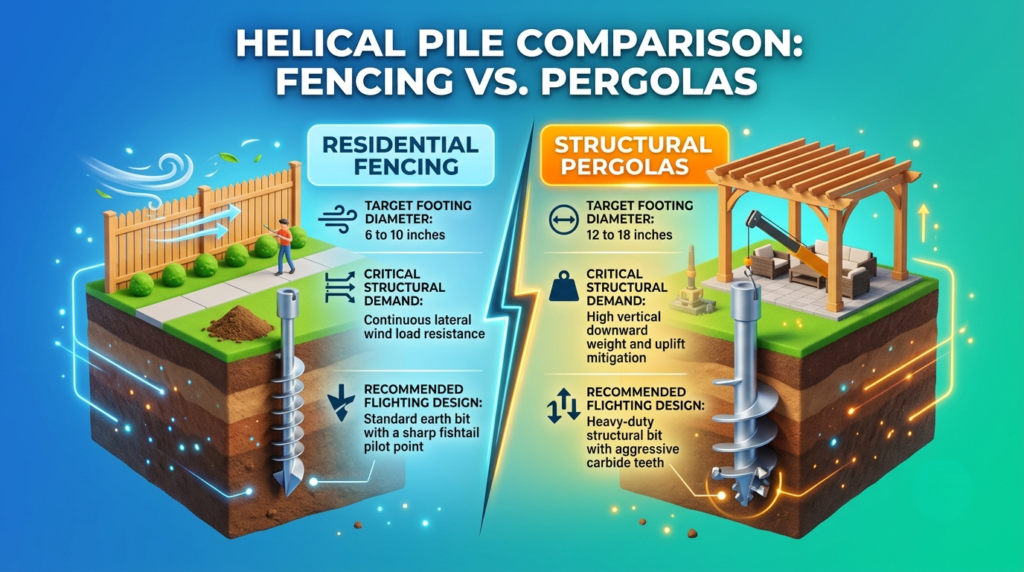
| Project Type | Target Footing Diameter | Critical Structural Demand | Recommended Flighting Design |
| Residential Fencing | 6 to 10 inches | Continuous lateral wind load resistance | Standard earth bit with a sharp fishtail pilot point |
| Structural Pergolas | 12 to 18 inches | High vertical downward weight and uplift mitigation | Heavy-duty structural bit with aggressive carbide teeth |
- Sizing for Fence Posts: You best go by the rule of thumb that your Skid steer auger attachment should make holes 2 to 3 times wider in diameter than the post itself (e.g., a 4×4 post will require a 10-inch hole for a clean install) so that there will be enough room for the concrete collar.
- Sizing for Pergola Footings: Like the significant load a one-story house has to carry, a pergola brings in a heavy dead weight that its footing has to resist. Strong footings translated into wide boreholes of 12-18 inches diameter made with a good Skid steer auger attachment will facilitate the proper load distribution across the soil footprint, prevention of sinking, etc.
- Cutting-Edge Configurations: Standard steel teeth work wonders in loose, clear loam. However, if your Skid steer auger attachment hits frozen subsoil, heavy roots, or compacted limestone, swapping to specialized carbide-tipped teeth saves hours of drilling downtime.
3. Step-by-Step Execution for Perfect Hole Alignment
Constructing beautiful straight fences or producing square pergola columns depends on starting with correct points measured, followed by drilling which must be vertical not having been slanted before the hole starts, by using a systematic, repeatable mechanical approach done inside the loader cab. or cab of the loader.
As it is typical for a skid steer to use lift arm that moves in an arc, the operator should make actively adjust the machine’s position at the lowering of the skid steer auger attachment. If the skid steer auger attachment will be allowed to drill the slanted and crooked holes, it will cause your layout to be off.
To achieve an accurate mechanical excavation, your Skid steer auger attachment must in fact stay perpendicular to the moving horizon at all stages of operation. Below is a stepwise method to keep the perfect alignment:
- Locate and Mark Subterranean Utilities: Safety Before Anything: Before bringing heavy machinery on site, contact 811 and have the underground utilities marked such as electricity, water, gas, etc.
- Establish Your Layout Lines: Essentially Make Layout Maps: Use string in tension as guide lines and marking paint with good visibility to mark the exact spot for individual footings.
- Position the Loader and Set the Pilot: Starting Point: Move the skid steer just over the spot and drop the Skid steer auger attachment so the pilot tip just barely touches the grass, which will give you the anchor point you are looking for.
- Initiate Low-RPM Mechanical Drilling: Actual Drilling: Start operating hydraulics at low revolutions per minute and let your Skid steer auger attachment produce a clean ring on the ground which will help keep the cutter centered on the spot.
- Compensate for the Loader Arm Arc: Staying on Track: Progressing further with the Skid steer auger attachment, make the minor adjustment in the front or back direction, whichever keeps the shaft vertical, to counter the radial motion of the loader’s lift arms.
- Extract Soil with Clean Spills: Getting Rid of Dirt: Reach the desired depth; Skid steer auger attachment leaves the hole slowly while still spinning. Its helical part brings the loose heap of soil up and lays it down around the hole.
- Maximizing Subterranean Structural Integrity
After mechanically boring a clean vertical hole with your Skid steer auger attachment, it is time to be more structural in implementing your perfect plumbing choices on the structural foundation itself.
Although a hole perfectly excavated by a Skid steer auger attachment may have a very high level of soil stability, if it stands for a long time before the concrete is poured, the soil at the bottom of the footing can settle or accumulate water, which will be detrimental to structural post-rot and sinking.
Among other things, a highly professional-grade pier foundation is all about clearing out loose debris and effective management and disposal of water. Water standing against the wood in the post can lead to rotting, so that is something that needs to be kept in mind when building your foundation.
- Clear Subterranean Loose Crumbs: After you have taken the Skid steer auger attachment out of the hole, make sure to remove any loose, uncompacted soil crumbs at the bottom of the hole so that the concrete will have solid, undisturbed earth to pour onto.
- Incorporate a Gravel Ballast Footing: Prior to installation, pour a layer of approximately 2 to 4 inches of clean, washed crushed stone to the bottom of the bore to facilitate proper draining in that area of the post
- Utilize Sonotube Rigid Forms: In the case of pergolas erected on sandy or unstable hillsides, using Fiber sonotubes helps eliminate the problem of weak sidewalls that collapse inward, thereby damaging the concrete mix.
- Maintenance Strategies for Heavy-Duty Drilling Systems
The metal frames, gearboxes and hydraulic components of your diggers have terrain and earth drills to the point that the worst bits are the skid steer auger attachment that cut blades from dull or the chains of these drives that while rolling make the torque from the forward drive the skid steer’s hydraulic auxiliary engine is forced to work twice as hard pretty much turning the skid steer auger attachment being that component wear and fuel consumption are increased by large amounts.
Preventative maintenance is a very simple plan to follow and just about always lead to smoother running of your Skid steer auger attachment and properly functioning project without unexpected breaks and shutdowns.
- Inspect and Replace Worn Wear Parts: Examine the center pilot point and outside cutting teeth of your Skid steer auger attachment before starting a working shift and identify any edges that have been chipped, cracked, or rounded so that they may be replaced immediately and you can be assured of continuing rapids penetration speeds.
- Monitor Gearbox Lubricant Levels: The planetary gear drives on your Skid steer auger attachment depend on the availability of clean, viscous gear oil to carry away frictional heat that arises from within. Follow the manufacturer’s schedule for checking and topping up the fluid reservoirs to avoid major gear failures.
- Clean and Cover Quick-Connect Couplers: Always wipe down the auxiliary hydraulic quick-connect sleeves before snapping your Skid steer auger attachment into your skid steer’s lines, keeping microscopic dirt and abrasive grit from entering your machine’s high-pressure hydraulic loop.
FAQs: Skid Steer Auger Attachment
How deep should I drill post holes for a residential fence or heavy pergola?
The minimum depth for holes to be made by posts for fences around residential property is normally one-third to one-half of the total post height aboveground (usually 24 to 36 inches). When it comes to heavy structural installations, such as timber pergolas, the post holes should be drilled down to below the frost line of your geographical region (usually 48 inches or more) so that the freeze-thaw cycle of winter does not cause the foundation to be lifted out of the ground.
What size auger bit do I need for a standard 4×4 or 6×6 post?
The diameter of a hole to be drilled for concrete foundation should be 2 to 3 times the width of the post. For instance, a standard 4×4 inch post (which measures 3.5 inches true size) will require a 10-inch diameter opening. On the other hand, a heavy 6×6 inch structural pergola post will need a 12 to 15-inch diameter bit to allow for a proper, load-bearing concrete collar.
Can a standard-flow skid steer handle heavy-duty planetary auger drives?
The answer is yes, most standard-flow skid steers operating within 15 to 25 gallons per minute (GPM) are very capable of running heavy-duty planetary drive systems. These planetary drives internally reduce the gear and multiply the low-flow hydraulic fluid into very strong rotational torque which makes these drive systems very effective for drilling moderate diameter holes even on standard-flow machines.
How do I prevent my skid steer auger from wandering when starting a hole?
Prior to touching the ground with your skid steer auger, press down and embed the tip of the pilot point to the soil surface. You must start the rotation at low idle without applying down pressure. Such a method will allow the pilot point to get the center established guide hole before the bigger cutter teeth can start to cut into the topsoil.
Should I choose a round or hex hub connection for my drilling attachment?
An unarguably well-liked choice for heavy-duty construction projects is the hex hub connection because the flat-sided design distributes rotational stress evenly across the drive shaft, completely eliminating the risk of the attachment pin shearing under high torque loads. Round hubs are common and work well for light landscaping, but they rely entirely on a single shear pin that can break when striking hidden rocks or thick roots.
How do I dig a perfectly vertical hole with a skid steer lift arm that moves in an arc?
Since ride skid steer’s lift arms move up and down along a curved radial path, you must actively correct the machine’s position while drilling. As you lower the attachment into the ground, slowly creep the loader slightly forward or backward in small increments to keep the drive head centered and perfectly vertical throughout the entire dig.
Is it better to pour dry concrete mix into the drilled hole or mix it beforehand?
To carry out heavy load structural posts such as large pergolas or privacy fence posts, high wind resistance will always mean that one should mix concrete with water before pouring. Pre-mixing ensures uniform hydration throughout the footing, eliminating dry pockets or weak spots that often occur when pouring dry mix directly into a damp hole.