
Skid Steer Operator Safety: Understanding Zone of Protection, ROPS, and FOPS Standards
Skid steer loaders are some of the most versatile and productive pieces of equipment in use today on construction sites, farms, and industrial areas. But their latest design with a compact frame, tight turning radius, and a front-entry cabin positioned right between movable lift arms, brings about a set of new operational hazards that need to be addressed with the Skid Steer Operator Safety measures.
You can’t ensure safety at work without knowing the standard engineering safeguards aimed at protecting human life. In this regard, Skid Steer Operator Safety is significantly based on the physical and operational dimensions laid out by the Zone of Protection, Roll-Over Protective Structures (ROPS), and Falling Object Protective Structures (FOPS).
Safety in heavy industries is not an option, a nice to have. Operators need to be well informed about the potential outcomes of their machinery malfunctioning, sacrificing stability or operating in an unpredictable environment.
This all-inclusive guide explains the engineering meanings, regulatory requirements, and on-the-job conduct essential for balancing the performance with the elimination of severe injury risks and unexpected equipment damages.
Explaining the Zone of Protection in Heavy Machinery
Zone of Protection can be understood as the defined, precise, 3-dimensional space in or around a heavy equipment within which position an operator is shielded from any mechanical hazards. To a large extent, it is that spatial zone inside the skid steer operator’s cab structure that is the operator’s Zone of Protection.
Due to design, it is through the front bucket or attachment that the operator gains access to the cab area in most skid steers; a highly vulnerable position is established at this point. However, once the operator is inside the cabin, the structural frame acts as a barrier against external physical factors.
In order to not compromise such an essential perimeter, operators must be completely committed to following the rules of operation. Simply extending an arm, leg, or head outside the structural constraints of the cabin while the engine is running, is enough to break the Zone of Protection and expose the operator to possible crushing by the lift arms. Several key points that will help understand the spatial boundary:
- Complete Containment within the Body: During the use of the equipment, operators should not only keep their hands, arms, legs, and head 100% inside the operator’s compartment but must also do so at all times.
- Operation Control within the Compartment: It is never acceptable for a person to either physically or electronically operate or activate the hydraulic joystick or foot controls from outside the seating compartment of the machine.
- Use of Three-Point Contact Method: The very act of entering and exiting the Zone of Protection must be carried out using the method of having a stable footing and handholds at all times, and facing the machine.
ROPS—Roll-Over Protective Structure, what is it?
ROPS is short for Roll-Over Protective Structure—a specially designed structural system to guard operators against being crushed in case the machine they are operating accidentally overturns or tips over.
Due to their relatively short wheelbase and the uneven distribution of their weight at raised heights, skid steers are among the machines whose center of gravity shifts quite easily on slopes, uneven terrain, or wet, slippery ground.
In case of an accident, intoxication fractures, low function of weatherization, and other problems arise in the way of dulling the strength of the ROPS, thus reducing the protective value of the system to the operator.
The major role of the ROPS is to ensure that the rollover situation is limited to the machine tilting at an angle not exceeding 90 degrees, thereby preventing the heavy machine frame from fully contacting the ground at the driver’s position.
However, if during a roll the operator is thrown from the seat, a ROPS frame would be no help. The ROPS being a system in its function, the steel overhead canopy is very much dependent on the internal restraint systems in keeping the driver safely enclosed in the survival zone.
- Seat Belt Must be Always Worn: It is the operator’s seat belt being tightly worn and secured by the operator that is a ROPS’ key dependability for providing the intended level of protection.
- Interlocking Mechanical Safety Bars: Nowadays, skid steers come with physical restraint bars that have to be lowered fully before the hydraulic locks can be released, the operator cannot simply escape the protective frame.
- Nil Structural Modifications: Making changes in the field, welding or drilling holes in a certified ROPS frame can drastically alter its load capacity and hence void its certification.
FOPS—meaning Falling Object Protective Structures
If ROPS mainly secures an operator against accidents originating from beneath or at the same level as a machine, then Falling Object Protective Structures (FOPS) protect the operator from the heavy object dropping down from a height. The roof of a certified skid steer cab is molded to withstand a large impact coming vertically and prevent crushing from top to bottom.
The FOPS are categorized according to the expected level of hazards in the environment. Level I protection is for resisting impacts of small falling objects such as tools, bricks, or debris mostly found in light construction and landscaping sites. Level II protection involves heavier and more powerful impacts. It guarantees protection against the likes of large boulders, heavy concrete slabs and falling trees prevalent in forestry and demolition sites.
- Level I Certification Compliance: Optimal for everyday work, this protects the cabin from occasional low-height small-object impacts and general debris.
- Level II Heavy-Duty Upgrade: Adaptation of this feature is quite common and often law requirement for demolition, forestry, and high-wall mining operations.
- Routine Structural Overhead Inspection: Operators should perform daily major inspections to ensure that the roof plate and structural weldments have not been contaminated by severe rust, dents, or stress fractures that may make vertical resistance to impact weaker.
Skid Steer Operator Safety Standards Comparison in a Nutshell
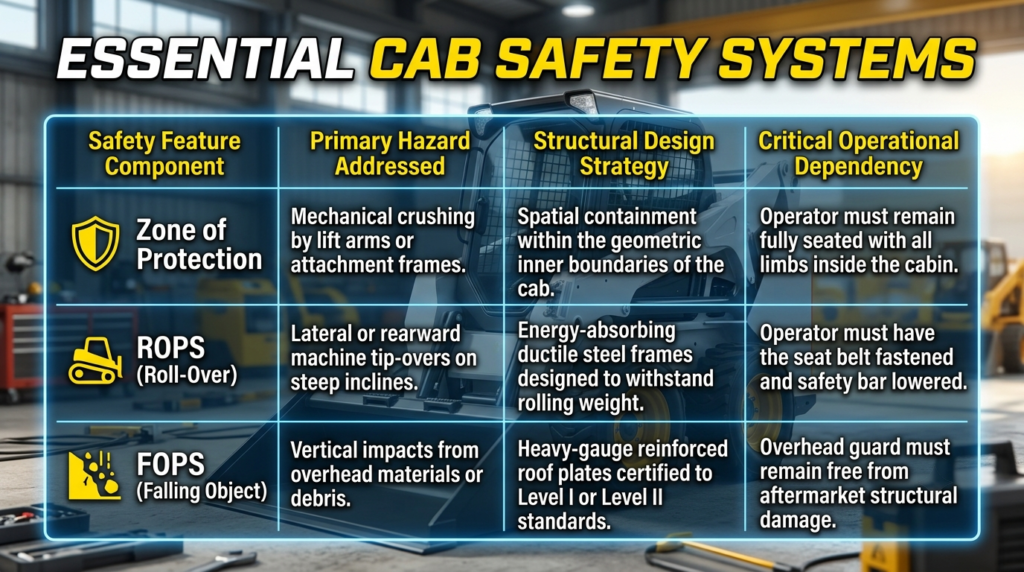
It is easier to grasp the complementary features of ROPS and FOPS which consist of the elements of a total operator safety system, by considering their intentions, designs, and operations along with the differences in the characteristics which create their unique and separate functionalities. Though off the same beat in preventing injury to the operator, each separately addresses the directions of actions that may cause injuries.
| Safety Feature Component | Primary Hazard Addressed | Structural Design Strategy | Critical Operational Dependency |
| Zone of Protection | Mechanical crushing by lift arms or attachment frames. | Spatial containment within the geometric inner boundaries of the cab. | Operator must remain fully seated with all limbs inside the cabin. |
| ROPS (Roll-Over) | Lateral or rearward machine tip-overs on steep inclines. | Energy-absorbing ductile steel frames designed to withstand rolling weight. | Operator must have the seat belt fastened and safety bar lowered. |
| FOPS (Falling Object) | Vertical impacts from overhead materials or debris. | Heavy-gauge reinforced roof plates certified to Level I or Level II standards. | Overhead guard must remain free from aftermarket structural damage. |
On-Site Safety Best Practices
Safety features set in hardware will not eradicate incidents completely; safety through exposure requires a continual commitment to safety each day and regular maintenance. Operators should always carry out a safety check on all mechanicals that have been built-in to provide them with the protection that they can depend on should it be necessary to the point of ready the atmosphere for the beginning of their work.
Besides a fluid-level check and lubrication of mechanical parts, a complete safety inspection prior to start-up is a must to assess the working condition of all harnesses, interlocks, and electronic safety devices. If a security device is the one that is not working properly or has been compromised by bypassing from the previous operator, cording the machine with a red tag and totally withdrawing it from service until certified repairs have been performed is mandatory.
- Safety Interlock Daily Testing: Make sure that when the operator is out of the seat or when the safety bar is raised, the engine cannot be started and the hydraulics are locked so as to prevent any movement.
- Carrying Loads at Low Height: When moving buckets or attachments, always carry them as close to the ground as possible to maintain a low center of gravity.
- Method of Slope Travel: Avoid traveling lateral hills; instead, go straight up or down with the heaviest end of the skid steer facing uphill.
FAQs – Skid Steer Operator Safety Measures
What distinguishes ROPS from FOPS on a skid steer?
ROPS (Roll-Over Protective Structures) is a system of cheaper parts designed to prevent crushing during a rollover or tip-over of the skid steer on a steep and unstable surface. FOPS (Falling Object Protective Structures) is an overhead protective canopy constructed to shield against hazards like falling stones, hand tools, or debris impacting the cab top.
Is it possible to weld or modify my skid steer’s ROPS frame?
No, under no circumstances, should you drill holes, weld on plates, or modify a factory-certified ROPS frame. Such actions change the structural integrity and heat treatment of the steel, which can cause structural failure and void its certification by OSHA or ISO.
How do control interlocks help maintain the Zone of Protection?
The control interlock acts as an electronic gatekeeper for the Zone of Protection. If the operator raises the safety restraint bar or gets up from the seat, the interlock will lock the hydraulic lift arms and driving systems to prevent any inadvertent movement during entry or exit of the cab.
For a skid steer in what scenarios is Level II FOPS protection mandatory?
Level II FOPS is the minimum protection level required for heavy-duty environments with the high probability of falling objects. This would include live demolition areas, forestry operations, open high-wall quarries, and mining sites where Level I covers are not sufficient.
What is the reason behind a seat belt being essential on a skid steer that has a ROPS?
While a ROPS frame provides a space of survival during a rollover, it is only effective as long as you stay within that space. The seat belt secures the operator to the seat so that in the event of a rollover, the operator is not thrown out of the cab and crushed by the rolling machine itself.
What is the right course of action if a crack is detected in the skid steer safety canopy?
Spotting any crack or crack-like dent on structures or finding severely corroded welds should lead to the operator immediately stopping the machine, locking it out, and tagging it out of service. No further usage is permitted until after inspection, repairs, or replacement performed by an authorized technician.
How can a skid steer be driven on steep slopes to avoid rollovers?
Maximum stability and minimum rollover risk can always be achieved by going straight up or straight down the slope rather than sideways across it. In addition to this, the heaviest end of the skid steer should be kept pointing uphill (which is generally reverse when you are empty and going downhill, or forward when you are fully loaded and going uphill).